Career Planning – Is now the right time?

Photo by Alex Green on Pexels.com

Thinking about the future can be daunting, especially as PhD student who has multiple years before graduating and entering the workforce. As a student, you often hear of two tracks, academia or industry. Although this may seem pretty clear cut, there are a variety of roles and jobs within both of these sectors. Early on in my PhD, I realized I did not want to stay in academia. However, I had no clue what I wanted to do, and honestly I still don’t have it fully figured out. Despite this, I started doing some career exploration during my PhD that put me on a path I am excited about and narrowed down my options. Despite having multiple years left in my PhD program, I am looking forward to the future and a career outside academia. Determining what you want to do with your life is not an easy path, but I hope to share some tips that made career exploration during my PhD manageable and exciting.

Take advantage of resources at your school and online 

Many universities and foundations offer career development tools, seminars, or other offerings. When I first started my PhD, I joined Beyond the PhD, a group focused on exploring careers outside of academia. Now I help manage content and events for the group. Along the way, I have learned about many professions and have been able to connect with professionals in fields I am interested in. Getting involved or attending career events is a great first step when you are in the early stages of career exploration.

Make a list of things you like and don’t like doing 

One of the best pieces of advice I got early on in my PhD was to keep a list of things I like doing and things I don’t like doing. As I’ve developed my skill set as a PhD student, I quickly realized that there are things I love to do, things I can tolerate, and things I never want to do again. For example, I love writing and science communication, and these are skills I have continuously worked on. One the flip side, early on in my PhD I developed a severe mouse allergy and decided that a career at the bench working with rodent models wasn’t for me. Knowing what you enjoy working on and what you do not can really help narrow down options when looking for jobs later on. 

Keep track of titles and roles you could see yourself in

Another great piece of advice I received was to keep track of titles and roles I could see myself doing after I graduate. Now, when I come across a career that resonates or seems interesting, I write it down to consider later. Sometimes, I will look up job postings for that role and the skills required for that opportunity. I currently have a running list of roles that I can now refer and add to as I continue to grow and learn during my PhD journey. 

Network

Networking and talking to people is one of the best ways to explore your options. You can learn about different roles, companies, and professions just by having a conversation or sending an introductory email. It is a great way to learn about new opportunities and make connections that may be beneficial when you are job hunting later on. Many schools and professional organizations offer events, seminars, or other ways to grow your network. Additionally, you can use your current network to connect you with other individuals who are working in fields that you may interested in. 

Track your skills 

It’s important to recognize the skills you have and ones that still need development. It’s also good to track this as you are continuing on your PhD or academic journey. Some skills might be obvious such as proficiency at certain techniques, assays, or programs. However, make sure to also record and develop soft skills that are arguably just as important as your ability to run an experiment. Soft skills are often translatable to many roles and can include things such as writing, presenting, communication, leadership, and the ability to work with a team. By understanding your skill set and areas where you excel or need development, you can then easily share this with potential employers or mentors. 

Make and IDP

An IDP or Individual Development Plan, is a resource available to students and researchers. The IDP concept is commonly used in industry to help employees define and pursue their career goals, but it is also great for those doing a PhD or post-doc.  The IDP provides exercises to help you examine your skills, interests, and values. It is a great and informational tool that can help with setting strategic goals for the future and understanding your strengths and weaknesses. More about IDP’s can be found here https://myidp.sciencecareers.org/.

Career Planning – Is now the right time?

Thinking about the future can be daunting, especially as PhD student who has multiple years before graduating and entering the workforce. As a student, you often hear of two tracks, academia or industry. Although this may seem pretty clear cut, there are a variety of roles and jobs within both of these sectors. Early on in my PhD, I realized I did not want to stay in academia. However, I had no clue what I wanted to do, and honestly I still don’t have it fully figured out. Despite this, I started doing some career exploration during my PhD that put me on a path I am excited about and narrowed down my options. I still have a few years before I complete my PhD, but I am looking forward to the future and a career outside academia. Starting down the path of career exploration during a PhD is not easy, but I hope to share some tips that make it manageable andexciting.

Take advantage of resources at your school and online 

Many universities and foundations offer career development tools and seminars amongst other helpful items. When I first started my PhD, I joined Beyond the PhD, a group focused on exploring careers outside of academia. Now I help manage content and events for the group. Along the way, I have learned about many professions and have been able to connect with professionals in fields I am interested in. Getting involved or attending career events is a great first step when you are in the early stages of career exploration.

Make a list of things you like and don’t like doing 

One of the best pieces of advice I got early on in my PhD was to keep a list of things I like doing and things I don’t like doing. As I’ve developed my skill set as a PhD student, I quickly realized that there are things I love to do, things I can tolerate, and things I never want to do again. For example, I love writing and science communication, and these are skills I have continuously worked on. One the flip side, early on in my PhD I developed a severe mouse allergy and decided that a career at the bench working with rodent models wasn’t for me. Knowing what you enjoy working on and what you do not can really help narrow down options when looking for jobs later on. 

Keep track of titles and roles you could see yourself in

Another great piece of advice I received was to keep track of titles and roles I could see myself doing after I graduate. Now, when I come across a career that resonates or seems interesting, I write it down to consider later. Sometimes, I will look up job postings for that role and the skills required for that opportunity. I currently have a running list of roles that I can now refer and add to as I continue to grow and learn during my PhD journey. 

Network

Networking and talking to people is one of the best ways to explore your options. You can learn about different roles, companies, and professions just by having a conversation or sending an introductory email. It is a great way to learn about new opportunities and make connections that may be beneficial when you are job hunting later on. Many schools and professional organizations offer various events or seminars to grow your network. Additionally, you can use your current network to connect you with other individuals who are working in fields that you may interested in. 

Track your skills 

It’s important to recognize the skills you have and ones that still need development. It’s also good to track this as you are continuing on your PhD or academic journey. Some skills might be obvious such as proficiency at certain techniques, assays, or programs. However, make sure to also record and develop soft skills that are arguably just as important as your ability to run an experiment. Soft skills are often translatable to many roles and can include things such as writing, presenting, communication, leadership, and the ability to work with a team. By understanding your skill set and areas where you excel or need development, you can then easily share this with potential employers or mentors. 

Make an IDP

An IDP or Individual Development Plan, is a resource available to students and researchers. The IDP concept is commonly used in industry to help employees define and pursue their career goals, but it is also great for those doing a PhD or post-doc.  The IDP provides exercises to help you examine your skills, interests, and values. It is a great and informational tool that can help with setting strategic goals for the future and understanding your strengths and weaknesses. More about IDP’s can be found here https://myidp.sciencecareers.org/.

Don’t be afraid to ask for help!

Besides talking to your PI or mentor, feel free to reach out to us at Beyond the PhD (2phdandbeyond@gmail.com) or find us on LinkedIn (https://www.linkedin.com/company/academia-industry-opportunities-group/?viewAsMember=true) or Twitter (@aiog_ct) for answers to career questions, career seminars, blog posts, and more!

To celebrate two years of Bolded Science, here is a throw back to our interview with the creator

Have you ever gotten tongue-tied trying to explain your research project to your parents? Or heard a scientific talk that was more acronyms than …

Interviewing Kerry Silva: Creator of Bolded Science

Perspective of a Mom and 1st year PhD student

My path to Graduate school is probably not as straightforward as the typical student. Six years ago I never would have conceived that obtaining my PhD was even a remote possibility. At that point in my life, I had just graduated from the University of Connecticut with a Masters in Immunology and was content to pursue a career as a Research Associate either in Academia or Industry. However, I first wanted to start a family so over the course of just four years, I had my wonderful three little boys and embraced my new role as “Mom”. During this time, I obtained a position as a Research Assistant here at the University of Connecticut Health Center and for three years I was able to contribute to projects in the lab where I gained valuable experience in cell culture, grant writing and manuscript preparation. As a result of my accomplishments and enthusiasm for research, my Principle Investigator suggested I continue my Graduate career as a PhD student and recommended that I enroll in the Biomedical Sciences program here at UCHC. For the first time I actually considered the possibility of obtaining my PhD as something tangible and within my reach. The three years of experience I obtained while working in the lab helped significantly with my confidence and made me realize that this was the career choice I wanted to pursue. Not only had I fostered a passion for research, but I’d also found a wonderful lab to work in that made me realize how important this field was and how what I did could have real implications in the medical/scientific field. So even though my pathway to this point in life has not been straightforward, I am happy that all my previous experiences have brought me to this point in my career. There have been many twists and turns along the way, filled with doubts and questions, but so far I am happy to be part of a program that challenges me daily and helps me be the best version of myself. Now, not only am I a Mom, but I also get this awesome opportunity to be a Graduate student as well. Some days may be difficult or down right challenging, but I’m excited for the path this journey will take me. 

Perspective of a Mom and 1st year PhD student

My path to Graduate school is probably not as straightforward as the typical student. Six years ago I never would have conceived that obtaining my PhD was even a remote possibility. At that point in my life, I had just graduated from the University of Connecticut with a Masters in Immunology and was content to pursue a career as a Research Associate either in Academia or Industry. However, I first wanted to start a family so over the course of just four years, I had my wonderful three little boys and embraced my new role as “Mom”. During this time, I obtained a position as a Research Assistant here at the University of Connecticut Health Center and for three years I was able to contribute to projects in the lab where I gained valuable experience in cell culture, grant writing and manuscript preparation. As a result of my accomplishments and enthusiasm for research, my Principle Investigator suggested I continue my Graduate career as a PhD student and recommended that I enroll in the Biomedical Sciences program here at UCHC. For the first time I actually considered the possibility of obtaining my PhD as something tangible and within my reach. The three years of experience I obtained while working in the lab helped significantly with my confidence and made me realize that this was the career choice I wanted to pursue. Not only had I fostered a passion for research, but I’d also found a wonderful lab to work in that made me realize how important this field was and how what I did could have real implications in the medical/scientific field. So even though my pathway to this point in life has not been straightforward, I am happy that all my previous experiences have brought me to this point in my career. There have been many twists and turns along the way, filled with doubts and questions, but so far I am happy to be part of a program that challenges me daily and helps me be the best version of myself. Now, not only am I a Mom, but I also get this awesome opportunity to be a Graduate student as well. Some days may be difficult or down right challenging, but I’m excited for the path this journey will take me. 

Career Seminar on Bioprinting Dec. 9!!

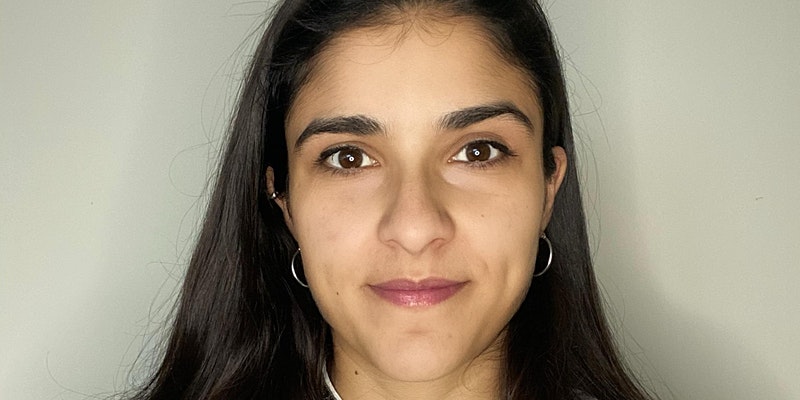
Join Beyond the PhD on December 9th to learn about a career in 3D Bioprinting Technologies and Advances!

Taci Pereira is the Vice President and General Manager of Bioprinting at 3D Systems, where she leads the development and commercialization of research tools for 3D bioprinting applications. Prior to that, she was Chief Scientific Officer at Allevi, a startup acquired by 3D Systems. Taci also leads the 3D bioprinting working group for the Regenerative Medicine Manufacturing Society, a professional society dedicated toward advancing manufacturing solutions for the field of regenerative medicine. Originally from Curitiba, Brazil, she has a B.Sc. in bioengineering from Harvard University, where she worked at the Wyss Institute for Biologically Inspired Engineering. Her research at the Mooney Laboratory for Cell and Tissue Engineering (Wyss) was focused on biomaterials for cancer immunotherapy, under the advisory of David Mooney (PhD).

A Year In Review: 2021

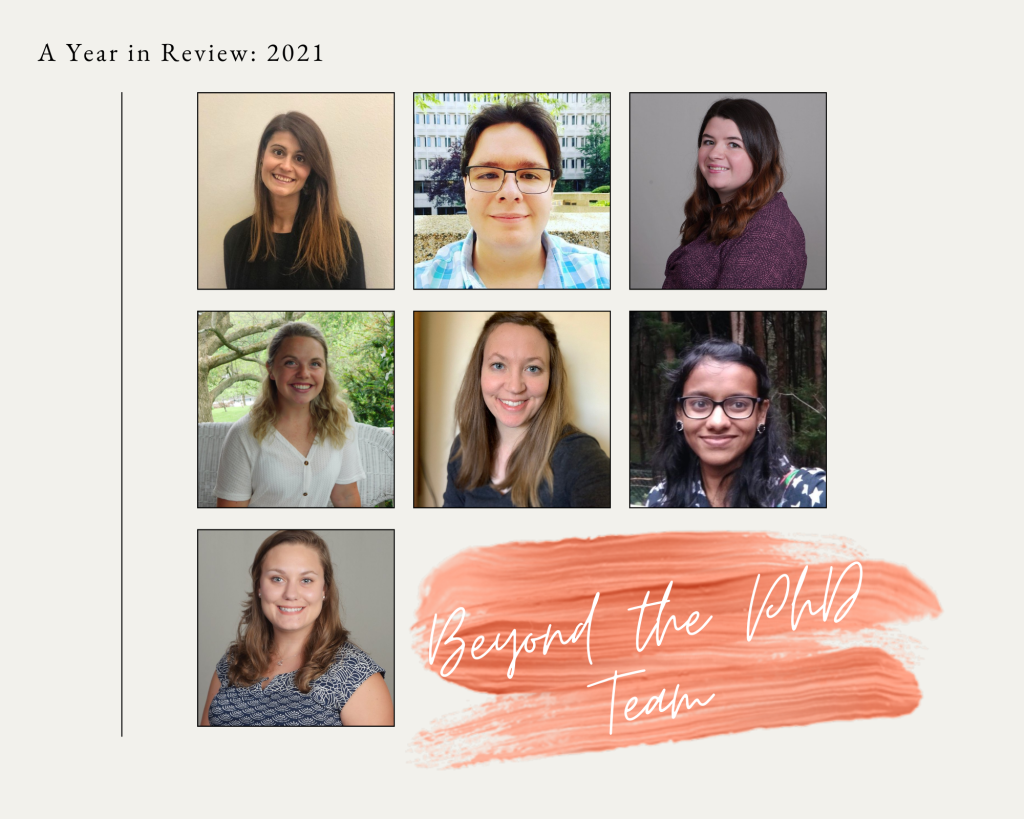
From left to right: Giulia Vigone, Robert Pijewski, Dominique Martine, Rachel Gilmore, Heather Wanczyk, Sai Nivedita Krishnan, Brittany Knight

Dear reader,

A year has come and gone. The world feels a little different, people are working from home, and not unlike the majority of the American workforce, people are freeing themselves from traditional work environments. The undergraduate and graduate training process is also changing. Students and early career professionals are often daring to dream differently about their careers and professional goals. Students in the fields of STEM are also considering new ways to apply their skills and knowledge. 

Beyond the PhD is a free resource for trainees and early career professionals in STEM for learning about alternative careers that are beyond classic academia. Currently we facilitate this learning process through three mechanisms: career focused Q/A sessions, annual networking events, and digital educational content. 

Since the pandemic began in 2020, we have fully immersed our group into the virtual world not unlike many organizations and businesses. This year, Beyond the PhD hosted eleven virtual events on careers in science related to drug discovery, policy, education, computational toxicology, biomedical illustration, to name a few. Many of these events were recorded and/or written about afterwards which are available freely on our website with new content published every Tuesday!

In March we collaborated with Dimensions Sciences, a nonprofit organization that provides scholarships for minorities in science, to host a virtual networking event that had upwards of 80 attendees. Our team at Beyond the PhD also grew as we added several new volunteers that helped to organize seminars and write blog articles for our website. 

In the new year, Beyond the PhD will be launching an Ambassador Program, a grassroots organization that will encourage students on college campuses to disseminate career development events among students in STEM majors. To become an ambassador please apply using the following application. Upper-level college students in STEM majors are highly encouraged to apply but the program is open to any active student on any college or university campus. 

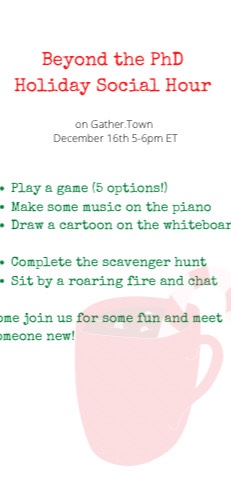
If you are interested in meeting the team you are invited to a social drop-in on December 16th from 5-6pm ET. To sign-up use this link: https://www.eventbrite.com/e/204614295867

Check-out our website to stay current with upcoming events through our website https://atomic-temporary-169259573.wpcomstaging.com.

Email us at 2phdandbeyond@gmail.com if you are interested in sharing your career journey or would like to participate in the spring 2022 networking event. More details will be shared shortly. 

We hope to see you around!

-The Beyond the PhD Team

Robert Pijewski, PhD & Brittany Knight, PhD: Co-directors of Beyond the PhD

Rachel Gilmore: Graduate student liaison UConn Health/Content Creator
Dominique Martin: Content creator/Blog writer

Natalie Sandlin: Ambassador Program Coordinator

Heather Wanczyk: Event Planner and Blog Writer 

Sai Krishnan: Content Creator and Blog Writer