Upcoming event: From PhD to Consultancy

Beyond the PhD is excited to welcome Dr. Aditi Vyas, a Life Sciences Consultant with Cerneos Group. Come learn about her career path on February 10th at 2pmET. Register below. Free event!

Aditi is a Life Sciences Consultant with Cerneos Group based in Boston, MA. At Cernoes she provides solutions to her clients for their projects in the biotech industry. Aditi is a recent PhD graduate in Biological Sciences from Michigan Technological University and transitioned into industry as a consultant. Join Aditi for a seminar where she will share her insights and experiences with fellow PhD’s, postdocs, and other graduate students on how she moved into a industry position as a PhD and navigating the search process.

7 Incredible Tips, PhD Candidate Approved and Tested, for Interviewing for Graduate School

Graduate school interviews can be a daunting process. These interviews may be conducted in person or virtually depending on the program. However, preparing for interviews can help you succeed, and have great interactions with potential faculty and colleagues. During graduate school interviews, you may meet with primary investigators or PIs whose lab you are interested in, other faculty, and current students. Making a positive and lasting impression during your interview can increase your chances of getting an offer into a masters or PhD program. 

Here are some general interview tips to help you succeed:

  • Review your CV/resume as well as other materials you submitted. Be prepared to talk about any experience that you listed. Remember that this is the only information the interviewer received and all they know about you. Also, don’t be afraid to go into more detail and talk about how your experience makes you an ideal candidate. 
  • Be ready to pitch yourself. You will most likely be asked about your background and why you are a good fit for the position. Be prepared to spend a small amount of time talking about yourself, your background, and your accomplishments. 
  • Make a good first impression. Dressing up a bit for the interview, being on time, and being prepared can help make a great first impression with your interviewer. 
  • Don’t be afraid to do a mock interview. Practicing answering interview questions can help you feel more comfortable and prepared for interviews. 

Here are some graduate school specific interview tips:

  • Look up the people you will be interviewing with. Knowing a bit about the research and projects your interviewers are working on can help conversation flow. It also shows your interest and commitment. Looking up their research articles, lab websites, or faculty profiles can help you get a better idea of who you will be interviewing with. 
  • Show your interest in the college/university. Knowing a bit about the place you could potentially spend the next 4-7 years of your life is important. Talking about how you would be a good fit at that specific university or department can help demonstrate your fit for the program. 
  • Ask questions. An interview is a two-way street! You also need to make sure that the program is what you want and that you can see yourself being a graduate student there. Don’t be afraid to ask pertinent questions about the research, funding, classes, graduate student life, and anything else you think is important. 

It can also be helpful to talk to current graduate students who have been through the interview process. If you do not have the chance to consult a current or former grad student, don’t fret. Below is some advice from two current grad students on conducting interviews:

“-I strongly suggest being familiar with the work of the PI who is interviewing you, so that you can better engage when they discuss their research and ask more specific questions.

-Have an answer to potential career plans and how getting a PhD is going to help in that pursuit.

-Come prepared with questions about the program, their lab, how they mentor, etc. Even if you end up asking the same questions to multiple PIs, you tend to get varied answers so you can form a full picture of the program. It also shows your interest.

-Remember that while they are the ones interviewing you, you are also there to determine whether the program will fit your wants/needs. Don’t be afraid to ask about the specifics of the program that matter most to you.

-Interview days are very long and can be exhausting, make sure to prepare in advance and get rest the day before.”

            – Natalie Sandlin, 5th year Biology PhD student at Boston College 

“How did you prepare

  • I most often used the faculty directory on a school’s website, which I had soon come to find out was VERY outdated in a lot of cases. I would recommend using a search engine like PubMed or Google Scholar to and reading the abstract or even methods section on some of the PI’s most recent last author publications for the most up to date research!

What kind of questions did you get

  • I think the most common one I got was to talk about the research I did.  Definitely prepare a good elevator pitch to introduce what you did, how you did it, and why they (or anyone!) should care, briefly of course. This would be a good spot to link to our elevator pitch materials.

What kind of advice would you give incoming students

  • Don’t be afraid to sell yourself. This does require some research on your part to figure out how you could contribute to the school or an individual PI’s lab, but I can almost assure you that work will pay off in the long run!”
  • Rachel Gilmore, 4th year Biomedical Science PhD student at UConn Health

How to Pitch Yourself as a Scientist: Helpful Tips

Beyond the PhD recently hosted a two-part series on elevator pitches. The event was co-sponsored by Westchester Biotech Project and Cerneos Group. The event took place over two days with a virtual first session followed by an in-person networking event held at UConn Health in Farmington, CT. Beyond the PhD co-founder Robert Pijewski put together an informational session on what makes a good elevator pitch and how to pitch yourself as a scientist. When giving a pitch, it’s important to keep them, concise, and up-beat. First impressions are made within the first seven seconds so every second counts when you meet somebody for the first time.

Some key things to keep in mind when preparing your Elevator Pitch:

  • Avoid science jargon and abbreviations
  • Make eye contact and present yourself professionally with an inviting look
  • Know your audience – not everybody you speak to will be a scientist
  • Speak concisely 
  • Answer the questions “Why you?” and “Why should they get to know you?”

The virtual event featured four pitch mentors including Judy Carmody (CEO of Carmody Quality Solutions), Victoria Donovan (CEO of Clinically Media), Aditi Vyas (Scientific and Clinical Consultant of Cerneos Group), Richard Tharin (CEO of Cerneos Group), and Joanne Gere (Co-Founder and Executive Director of Westchester Biotech Project). After presenting their pitches, students worked in groups with one of the mentors to prepare and practice their own pitch. 

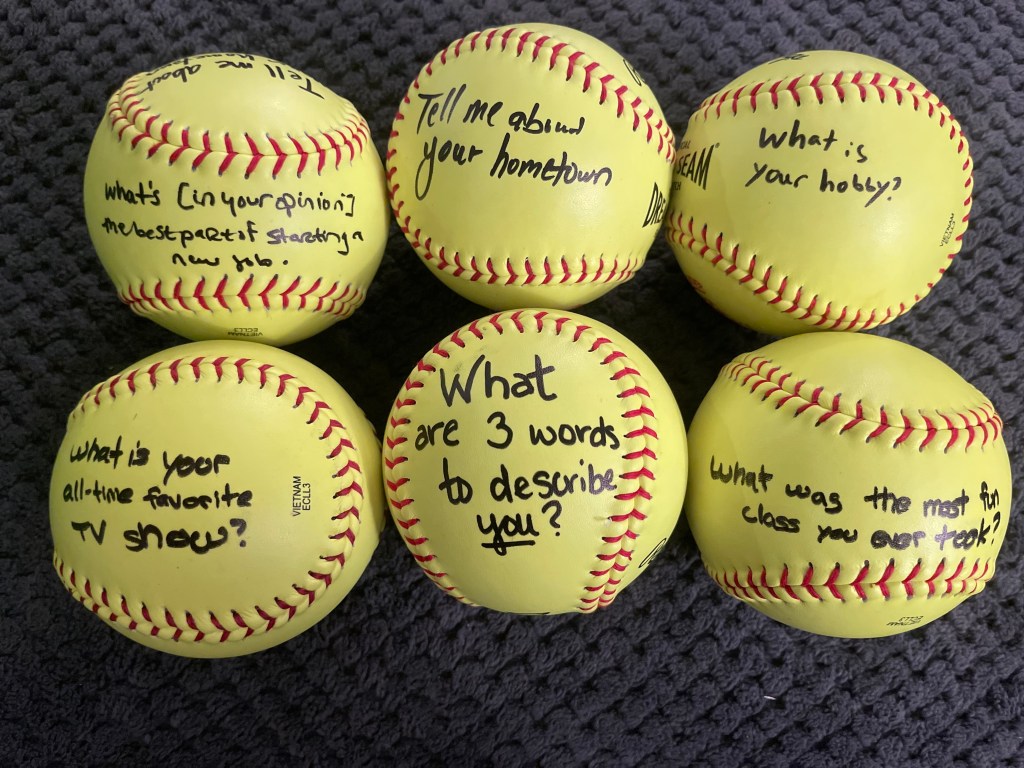
Picture taken from the Elevator Pitch Event in Farmington, CT. Examples of “softball” questions attendees crafted to ask as icebreakers during the networking event.

The in-person networking event at UConn Health was hosted on October 20th. Local scientists and incubators gathered to meet each other, and students had the opportunity to practice their pitches. One of the groups present was Action Innovation Network, a group located in southeastern Massachusetts, executive director Joan Popolo represented the group and talked about the amazing projects coming out of serval incubators in and around New England. Joanne Gere pitched the idea of using softballs to “get the ball rolling”. Conversations were started by asking a question that was featured on a softball and the ball was passed on to the next person. The exercise encouraged everybody to think beyond their role as a scientist. Brittany Knight of Beyond the PhD said that “we are more than scientists, we are people too—ask if anybody is reading a good book, ask about any hobbies.” One of my favorite questions was “Tell me about your hometown”. Scientists often study far away from home. It was amazing to learn about where many of these scientists came from. This event encouraged collaboration, networking, and everyone honed their pitching skills.

To learn more about our sponsors check out:
https://cerneos.com/about/

https://westchesterbiotechproject.org/

Check out our mentors:

https://www.carmodyqs.com/

https://clinicallymedia.com/about/

https://www.actionnewengland.org/

Interested in a Career in Pharma?

Beyond the PhD is excited to welcome Dr. Seth Garren, Head of Genomics in Precision Oncology at Sanofi. Join us for our first Career Discovery Seminar of 2023. Dr. Garren will join us on Thursday January 12 at 2pm to share his career journey. Register now to attend! FREE EVENT!

Seth Garren, PhD is the Head of Genomics in Precision Oncology at Sanofi in Cambridge, MA. Seth earned his bachelor’s degree in Molecular and Cell Biology and his PhD in Biomedical Sciences from the University of Connecticut. His PhD thesis was on the global analysis of gene expression changes in cells infected by the oncogenic mouse polyoma virus. Seth went on to do a postdoc at Massachusetts General Hospital where he developed the ability to profile extracellular vesicles from plasma of cancer patients and applied single cell RNASeq to mouse models perturbed with immune checkpoint blockade to understand immune cell response.

In 2018, Seth joined the NGS Technology Center at Pfizer Kendall Square where he worked to generate transcriptome data in collaboration with Rare Disease, Internal Medicine, and Inflammation & Immunology Research Units. He developed automation protocols for bulk, CITEseq, and Hashed single cell library processing. In 2021 Seth became the co-lead of the NGS Technology Center where he worked on applying bulk, single-cell, and spatial transcriptomics to different targets in the therapeutic area portfolios. This led to identifying treatment based off-target effects for repeat expansion diseases, characterizing immune cells driving fibrosis in non-alcoholic steatohepatitis, and leading the generation of spatial data for different mouse models.

Seth currently leads the US Genomics team in applying bulk, single cell, and spatial omics technologies to drive decision making for multiple project team’s drug candidates as well as profiling drug response and disease progression in patient samples from various cohorts in support of oncology

Register here: https://www.eventbrite.com/e/504786729697

Highlights from 2022: Career Seminars Revisited

Revisiting the year, we thought we would compile the career seminars from 2022. Check out the video to view the events and read short summaries or highlights from event blog articles to learn more about the 2022 featured careers. Follow us on social to stay up to date with upcoming events!

Summary of 2022 Beyond the PhD Career Events

Follow us on social to stay up to date with upcoming events!

Biochemist to Director for Portfolio Strategy at Cambridge Epigenetix

Beyond the PhD recently had the pleasure of hosting a seminar by Dr. Tom Charlesworth who serves as the Director for Portfolio Strategy at Cambridge Epigenetix. After obtaining his PhD in biochemistry from the University of Cambridge, he worked at a medical communications agency and the Wellcome Trust which allowed to gain a repertoire of non-scientific skills relevant to his current role at Cambridge Epigenetix. 

While he had initially planned for a career in academia, he realized that he wanted to explore non-academic careers at the end of his PhD program. One of his first positions was at a medical communications agency that was involved in educating medical personnel on pathophysiological research areas that pharmaceutical or biotechnology companies are focused on and essentially serve as a liaison between the companies and doctors. He discussed his transition from benchwork to office work and his collaborations with various internal and external teams on different projects. He also talked about transferrable skills from a PhD stint that might remain invisible in an academic track. Some of them are listed below.

  • Time management
  • Attention to detail
  • Scientific writing skills
  • Critical thinking
  • Analysis of complex information

He had then moved on to a position at the Wellcome Trust managed translational funding schemes which helped him understand how the research funding process works as well as transition of academic research to the clinical stage. His time at the Wellcome Trust allowed him to generate a network of industry contacts that allowed him to explore career opportunities in the biotechnology or pharmaceutical industries. He then wanted to expand his skill set in the intellectual property (IP) realm which led him to a position at the School of Medicine in the University of Cambridge where he dealt with contract negotiation and diligence. He consequently moved on to the Cambridge Enterprise which deals majorly with technology transfer. This position allowed him to learn more about commercialization and IP management. He talked about the importance of charting your own path by talking to a wide variety of people on their career paths instead of following a path already taken by another individual. 


He then moved on to a position as a Contracts and IP Manager at Cambridge Epigenetix (VEGX) where he could use the skills he had gained in previous positions like contract negotiation and IP management. He also talked about his role in the manufacturing and commercial strategy verticals. CEGX provides a platform to simultaneously analyze genetic and epigenetic information from a sample. He discussed his current role in the company which involves making decisions on the products that need to be manufactured based on integration of different inputs based on customer feedback as well as current research articles and patent information. He concluded his talk with the important point that there is no right path for individual career progression.

Career Comparison: Genetic Counselor vs. Clinical Geneticist

Genetics and genomics are currently, and have been, a hot topic in science and medicine. Several career paths are available to those interested in the field of genetics, such as becoming a genetic counselor or a clinical geneticist. Both of these careers are constantly expanding to improve and advance the state of healthcare and our understanding of genetics as a whole, however, there are key differences between these two genetics experts.

Clinical geneticists are specialized physicians who are responsible for the care of patients in a clinic, private practice, or hospital, and are often involved with translational or clinical research. After obtaining a medical degree (MD, DO), clinical geneticists must complete a two-year residency training in medical genetics and genomics, and must earn certification from the American Board of Medical Genetics and Genomics (ABMGG). By the end of their training, clinical geneticists are experts in evaluating, diagnosing, and treating genetic conditions in patients of all ages. Additional training is available to those who wish to further specialize in areas including clinical biochemical genetics, laboratory genetics, cytogenetics, and molecular genetics. Clinical geneticists often lead medical genetics healthcare teams, working in close collaboration with genetic counselors, physician assistants, nurses, and more.

Genetic counselors are healthcare professionals who obtain advanced training in medical genetics and counseling to guide and educate patients seeking to learn about how genetic disease may impact themselves and their families. They work in a variety of settings, including hospitals, private practice, laboratories, and public health, delivering genetic education, and interpreting genetic tests. After obtaining a bachelor’s degree in a related field, genetic counselors must complete a master’s degree program that has earned accreditation. Eligible graduate students from master’s programs can obtain board certification via the American Board of Genetic Counseling. Genetic counselors usually, but not always, work in collaboration with a clinical geneticist or other physicians in the evaluation and treatment of genetic disease. It is common practice for genetic counselors to specialize in one specific medical field such as prenatal care, cancer, or cardiovascular care. However, many genetic counselors are now entering industry in roles such as a Medical Science Liaison.

TODAY at 3pm ET! From PhD to Stem Cell Engineer

Beyond the PhD is excited to welcome Vincent Truong, Co-Founder & COO of Anatomic Incorporated. Come learn about his career path!

Date and time

Tue, November 29, 2022, 3:00 PM – 4:00 PM EST

Location

Online Access link

About this event

  • 1 hour
  • Mobile eTicket

Vincent Truong is Co-Founder & Chief Operating Officer (COO) of Anatomic Incorporated. He is a stem cell biologist by training and currently develops cell based assays using human induced pluripotent stem cell derived neurons for neurological drug discovery and toxicology. When he isn’t in the lab, he is traveling to conferences and setting up collaborations with leading academic labs and biotech companies.

Potential talking points :

Journey from staff scientist in academia to biotech start-up co-founder

The joys of wearing many hats

  • Assay and product development in the lab
  • Sales and BD
  • Marketing
  • Data analytics
  • Finances

What is Beyond the PhD thankful for this holiday season?

We hope you had a great holiday among family and friends. Hopefully you were able to take some time away to relax and enjoy! From the team at Beyond the PhD we wanted to share a little about what we are thankful for!

Rob is thankful for finding a full-time position teaching at Anna Maria College. “My journey through STEM, I have been incredibly lucky to work with amazing individuals that have helped me find my career as an educator”. Rob is also thankful every day that he gets to work with an amazing team at Beyond the PhD. “I am beyond grateful that I get to work and build content with a dedicated, talented, and passionate group of individuals year after year. A team that helps bring my dreams into reality.”

Britt is thankful for the amazing opportunities Beyond the PhD has given me as a leader, mentor, and career enthusiast. “I am thankful for all the incredible people I’ve been blessed to meet during our office hours programs, seminars, networking events, and new partnerships! I am excited to see where 2023 takes us!”

Rachel is immensely thankful for her support crew, both inside of the lab and out. “After a year of big happenings – switching PI’s, modifying my thesis project, returning to in-person conferences, becoming a published author for the first time, and getting my wisdom teeth out – I have never been more grateful for my incredible partner, family, friends, and co-workers. I’m looking forward to this coming year to be one of growth, stability, and some first authorship publications. It truly takes a village to complete a PhD, and I’m so lucky to have my village beside me.”

Dominique is thankful for great peers and mentors in grad school! “I am surrounded by people who help me succeed every day. I have quality mentors who care about my training and growth and allow me to explore career paths outside academia. I also have wonderful lab members, peers, and friends who make the grad school experience so much better. I’m so thankful that I get to work and collaborate with these people every day.”

Natalie is thankful for quality mentors and mentees in grad school! “I have been very fortunate to have a number of formal and informal mentors to help guide me through the uncertainty that research and a PhD program can bring. And through these mentors, I’ve also gained insight on how to be a good mentor to my undergraduate students in the lab, who are all amazing and I’m very happy I get to work with them!”

Sai is thankful for finally finding a lab for her dissertation research after a year of lab rotations. “I    was incredibly lucky for being able to explore different research areas through my rotations and to finally land a lab with an amazing team. I am also beyond grateful for my community of friends and colleagues at the Jackson Laboratory, UConn Health and Beyond the PhD.”