
Considering a Career in Genetic Counseling?

This article was written by Mariangelie Beaudry a Beyond the PhD’ Spring 2022 Campus Ambassador. She is a rising senior at the University of Hartford studying biology.

Beyond the PhD recently hosted Jennifer Stroop, a genetic counselor for the Hereditary Cancer Program at UConn Health Center to discuss her career path. Before becoming a genetic counselor, Jennifer received her MS in genetic counseling from the University of Cincinnati. She has held her position at UConn Health since 2001. Jennifer provided her insight on what it is like to be a genetic counselor and provide advice for prospective students interested in careers in genetic counseling. Jennifer explained what genetic counseling is through the definition provided by the National Society of Genetic Counseling. They state that they are healthcare workers who are specialized in an array of specialties such as prenatal, pediatric, oncology, and many others. Jennifer then described what she does as a genetic counselor through a case study. As a genetic counselor in hereditary cancer, she primarily sees breast and ovarian cancer patients, generally in the age range of 20 to 70 years old. In a typical consultation, she spends about 30 to 45 minutes chatting with the patient about their medical history and family medical history. She highlighted the importance of the core concept of risk assessment in familial and hereditary cancer. When discussing risk assessment, this can single-handedly affect the impact of the medical management of the patient she is working with. Jennifer also elaborated on the counseling portion of genetic counseling where key things to keep in mind are the benefits and limitations to taking a genetic test, the various outcomes, and who else may be at risk by the results. 

Jennifer was able to provide statistics on the profession of genetic counseling and how it is constantly evolving and growing. As of 2021, there are over 5,000 certified genetic counselors. Within the last ten years, genetic counseling has increased by over 100% and is anticipated to grow another 100% over the next ten years as well. Jennifer explained her experiences with the evolution as rewarding to have a continuation of education. She has especially enjoyed the aspect of collaboration amongst other divisions of genetic counseling such as cardiac, prenatal, and pediatrics. She also cited how the National Society of Genetic Counseling has expanded to discussing growth in terms of diversity, equity, and inclusion (DEI) across the genetic counseling profession. 

After providing her insight into the profession and giving some advice for prospective genetic counselors, Jennifer answered some questions from the audience. The first question was in regard to picking an area of study as a new graduate. In response, Jennifer discussed her experience in deciding which specialty she chose. Jennifer wrote her thesis on cancer genetics and then gained some experience in both prenatal and pediatrics. She explains during graduate school the training will prepare you for all areas of study and it is best to follow what you desire the most; for her, it ended up being cancer genetics. Another question that Jennifer received was regarding patients: how long does a genetic counselor see a patient after care? Jennifer explained that this is very much reliant on which area you are practicing in, and the amount of risk posed by the genetic test that is performed. From her experience, there are not many meetings with patients once her care has been complete, but for divisions in pediatrics that can be very different. Other great questions that Jennifer fielded included what is the biggest challenge she faces as a genetic counselor and what is the most rewarding aspect of her career. She stated the most challenging part of genetic counseling is receiving inconclusive results of genetic testing. Patients always come in with questions and it can be difficult to not have answers for families. On the contrary, the most rewarding thing is being able to have extensive amounts of time with her patients. She enjoys having the time to hear about patients’ family histories and the concerns of her patients. One of the last questions that Jennifer received was, “What is the biggest piece of advice you have for prospective students that are looking to go into the field?” Jennifer suggested checking out the National Society for Genetic Counseling website, as it has lots of resources for prospective students and is a great starting place to begin a career search. Jennifer mentioned that she loves what she does and loves the people she works with. She closed by recommending everyone finds a workplace that makes them feel the same.

As a student who is wanting to become a genetic counselor and about to apply to a master’s program, I found speaking with Jennifer was extremely insightful. I was able to see more of the profession and what it was like from her perspective working with hereditary cancer. 

A Few Words on the Return of In-Person Conferences

With the return of in-person conferences coming in hot, there are some things that can be easily looked over or forgotten. I recently attended my first two in-person conferences of grad school. Below you’ll find a list of things that I found helped (or maybe that I had forgotten) during these events.

  • Don’t be afraid to sit alone. Whether it be at a meal or before a talk, if you aren’t the type of person to break the ice, don’t feel pressured into having to ask someone to sit with them. Even if you are typically an outgoing individual, you don’t always have to be the first one to introduce yourself. I met some of the best people from taking a seat at an empty table and having others come up to ask if they could snag a seat next to me.
  • Don’t be afraid to sit with someone else. On the reverse, if you see a group of people who pique your interest, you can absolutely make the move to ask to sit with them! Remember, everyone is in the same situation and most likely hasn’t been to a conference recently. A lot of trainees have been lacking in the area of networking and social interactions over the last few years, so we’re all a bit rusty.
  • Check the weather for wherever you’re going. Nothing is worse than being uncomfortable in what you’re wearing during a time where you might already be a little stressed. Be sure to check the weather while packing to ensure the elements don’t one-up you.
  • Pack for free time. Also regarding packing for a trip, pack at least one non-business attire outfit for if you have some free time. Speaking from personal experience, you don’t want to be walking a few miles through a garden in your dress clothes while you wait to leave for your flight. Even if you don’t end up using the outfit, you won’t be upset for being over-prepared.
  • Bring a leisure reading book. It’s okay to not be tuned into science for 24-hours a day while you’re at a conference. In fact, it might be better to take a brain break every now and again. Plus, who doesn’t love a good airport read?
  • Don’t feel obligated to do work while there. Remember that you’re at the conference to learn, so you don’t want to miss the opportunity to soak it all in. It’s easy to get caught up in all the PI’s on their laptops – checking emails, writing manuscripts and grants, or scrolling through PubMed. I’m not saying you have to fall off the grid completely, but it’s reasonable to ask to miss a lab meeting or class while attending a conference if you feel comfortable doing so.
  • Practice your elevator pitch of your research. Before arriving at the conference, it wouldn’t hurt to do a few quick run-throughs of your elevator pitch so that you have your personal introduction down. A good outline would be [Greeting] + [Your Name] + [Your Position/Title] + [Where you work] + [1 sentence summary of your research].
  • If there is a Slack channel or online platform, use it to network. With hybrid conferences becoming the newest normal, I often find organizers will use Slack or some other platform so that attendees can engage whether in-person or virtual. Use this to your advantage and post in the introductions channel. Feel free to include things like a fun fact about yourself, if you’re currently searching for a new position, or a shameless plug for people to come see your poster/talk. That’s what these platforms are for!
  • Keep track of who you meet and interact with. Often conferences will have a list of attendees and their contact information as a part of the abstract book. Feel free to jot down notes there about who you meet during the conference so you remember when the conference wraps up. For shorter conferences it might not be such an issue to remember people’s names, but for longer conferences it becomes increasingly difficult to remember all of those conversations.
  • Send your invitations to connect in a timely manner. Once the conference concludes, be sure to send your LinkedIn or email invitations to keep in contact with all the new connections you made. The networking aspect of being in-person is definitely richer than what we’ve had access to online, so make the most out of all of your interactions.
  • Take time to recharge your social battery. After a few years of isolation, it’s easy to feel drained more quickly than we used to. Feel free to take some time to yourself if you feel tired or over-stimulated without judging yourself for feeling that way. A few minutes of quiet can be more beneficial than going to that extra workshop or staying out late after dinner.

Using LinkedIn to Create Your Brand and Network

What is LinkedIn and why should you have one?

LinkedIn is a social media site like no other. The site is a virtual platform for professionals to connect, share, learn, and network. At any stage in your career, LinkedIn can be a useful tool and can help you “link” up with professionals in your field, learn about different careers, find jobs, and much more. Think of LinkedIn as your own professional brochure where you can develop your personal brand and showcase your skills and accomplishments. You can use LinkedIn to not only connect with others, but also demonstrate your knowledge, credibility, and expertise. LinkedIn additionally allows key decision makers and recruiters to see your profile for things such as jobs, internships, consulting, and other opportunities. 

Although some early career professionals such as students may be hesitant to make a LinkedIn page, it can be beneficial long term. Using this platform can help you learn about different careers, expand your network, and explore career development opportunities. The LinkedIn user base is large and global. In fact, according to https://kinsta.com/blog/linkedin-statistics/, LinkedIn has over 810 million members from over 200 countries with over 57 million registered companies. Many of these members are actively engaged with the platform with 40% of them accessing it on a daily basis. 

Getting the most out of LinkedIn 

Although everyone’s experience with LinkedIn will be different depending on their careers and goals, there are some simple tips and tricks to get the most out of this platform. First, it’s important to know what you can do with LinkedIn. This includes professional networking, building connections, staying in touch with former colleagues and associates, finding internships or jobs, following companies, exploring careers, getting career advice, joining interest groups, and building/promoting your brand. 

Here are some tips on how to get the most out of LinkedIn. Always make sure to keep your profile professional since you never know who might decide to visit your page. Along these lines, it’s also important to keep your profile complete and up to date even when you aren’t actively job searching. Another way to be more engaged with the site is to post and also engage with other posts that come up on your feed. You can also use LinkedIn groups to explore interests and career opportunities. LinkedIn is overall a great way to connect and chat with other professionals, job search, and do career exploration. 

LinkedIn Premium is also a paid option for those who need more than the what the basic features offer. Although there is a monthly fee, Premium offers in mail, expanded searches, premium search filters, expanded profile views, the ability to see who’s viewed your profile, profile organizer, saved search alerts, reference search, as well as easier introductions and connections. Premium can be a great resource if you are actively job hunting. 

Creating and Building Your Brand with LinkedIn 

Think of your LinkedIn profile as a digital resume. It’s a great way to market yourself and build your individual brand. You should use your profile to highlight your education, skills, accomplishments, involvement, and anything else relevant. There are things you can do to make yourself stand out against the rest. Your profile picture is one of the first things connections or recruiters see. Some tips for a great LinkedIn picture are making sure that it’s clear and high resolution, has only you in it, and is professional. Often a quality shot of your head and shoulders will do the trick. You can also customize your LinkedIn profile URL or do things such as sharing your personal website or blog if you have one. LinkedIn now gives you the ability to upload your CV or resume to the site and to use it for job applications. This can help potential employers or connections get a more complete understanding of your qualifications. 

A final way to enhance your profile is to have skills, endorsements, and recommendations on your page. Sharing skills on your LinkedIn profile is a great way to showcase your abilities to other members. You can have a maximum of 50 skills in a profile, and LinkedIn will automatically sort your skills into different buckets. Once a skill is added, your first-degree connections can validate your skills by endorsing them. Endorsements can strengthen your profile and increase its visibility. It’s important to note that your top three skills are the most visible ones. These are also the most likely to be endorsed since these are the skills that show up for endorsement when you connect with a new person. You can also have recommendations on your LinkedIn profile. A recommendation is a written testimonial that is added to your profile by a connection who took the time to write out why you are a professional worth working with. Once a connection writes you a recommendation, you can accept, dismiss, or ask for a revision of the recommendation. A recommendation is a great addition to your profile and often adds more value than an endorsement.  

Growing your network and connecting with LinkedIn

            You can use LinkedIn to connect with current and colleagues, peers, acquaintances, experts in your field, and others. It’s perfectly okay to connect with someone you don’t know if you are looking to get to know about their career or even just network. Many people are often happy to connect, talk about their career journey, current position, or answer questions. LinkedIn can be a great resource for career exploration and advancement. Networking during the pandemic has been especially hard, and LinkedIn can be a tool to meet new, like-minded people. In general, LinkedIn members are more likely to connect when there is a personal note. One caveat is that LinkedIn limits your introductory message to 300 characters. With this limited space, it’s important to make a strong impression, connect via a common ground, or if possible, connect via a shared connection. Don’t be afraid to reach out and grow your network! You never know what opportunities may happen because of it. 

Upcoming Career Showcase: Medical Science Liaison

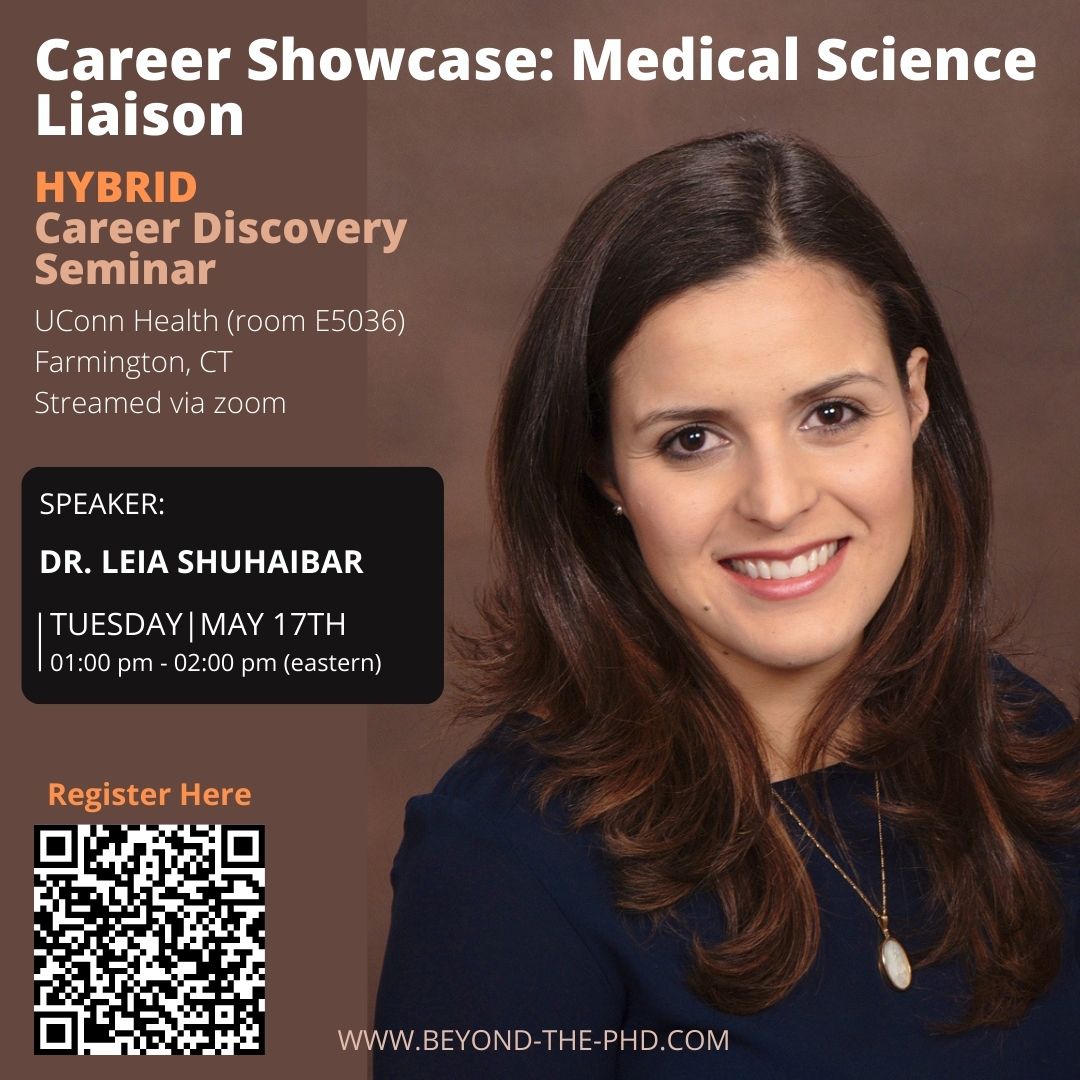
Beyond the PhD is excited to welcome Dr. Leia Shuhaibar, a Medical Science Liaison, for our first hybrid career discovery seminar on Tuesday May 17th at 1pm ET. This event will be streamed via Zoom, as with most of our recent events, but we will have the in-person portion on campus at UConn Health in conjunction with the Cell Biology Department. Due to COVID restrictions, in-person attendance is limited to students, faculty, & staff at UConn Health Center only. We apologize for any inconvenience, but look forward to hopefully continuing more inclusive hybrid events in the future as it becomes safe to do so.

Our speaker, Dr. Shuhaibar, is a UConn alumna, having completed her Ph.D. studies at UConn Health in 2015. Under the mentorship of Dr. Laurinda Jaffe, Leia investigated the signaling pathway controlling oocyte meiosis in mouse ovarian follicles. Later, as a Postdoctoral fellow and Assistant Professor, Dr. Shuhaibar investigated clinical applications of reproductive biology research and translated discoveries into developing a new therapy for bone growth disease. She also collaborated with the UConn fertility clinic and worked as an Embryologist in the IVF lab helping infertility patients. For family reasons, Leia and her family moved to Texas where she took a 1-year break, taking care of her children and searching for new career opportunities. In August 2021, Leia started her position at Ferring Pharmaceuticals, a pharmaceutical company in reproductive medicine. In this role, she is applying her research, teaching, and embryology experience to support physicians treating infertility patients. Dr. Shuhaibar will be giving a seminar about her career path on Tuesday, May 17th at 1PM ET. Registration for the event is free and is open to anybody interested. To attend the event, you must register using the link below. In-person attendees also must register using the link below and select “In-person Attendance” for your ticket option.

We look forward to seeing you there, whether it be in person or virtual!

Summer Office Hours

This summer, Beyond the PhD is trying something new. We are offering a program called Summer Office Hours. For 4 years, we have offered seminars, networking events, and opportunities for you to build upon your own working documents. So what is the purpose of this program? Well, like many career development groups, we are offering the chance for you all to meet with us one-on-one to go over anything you’d like, whether it be your resume, your CV, your LinkedIn page, etc. Maybe you want to talk to us about career transitions, or ask us about our experience with academia and industry. Wow, so what’s the catch? – it is FREE. Many other programs make you pay for these services. We don’t think that is necessary. We ARE trainees HELPING other trainees. It has been our mission the whole time. So give us a try, sign up below, and if you’re happy, leave us a warm note to tell others what you thought. 

Amanda Rendall: Transitioning into an MSL Role

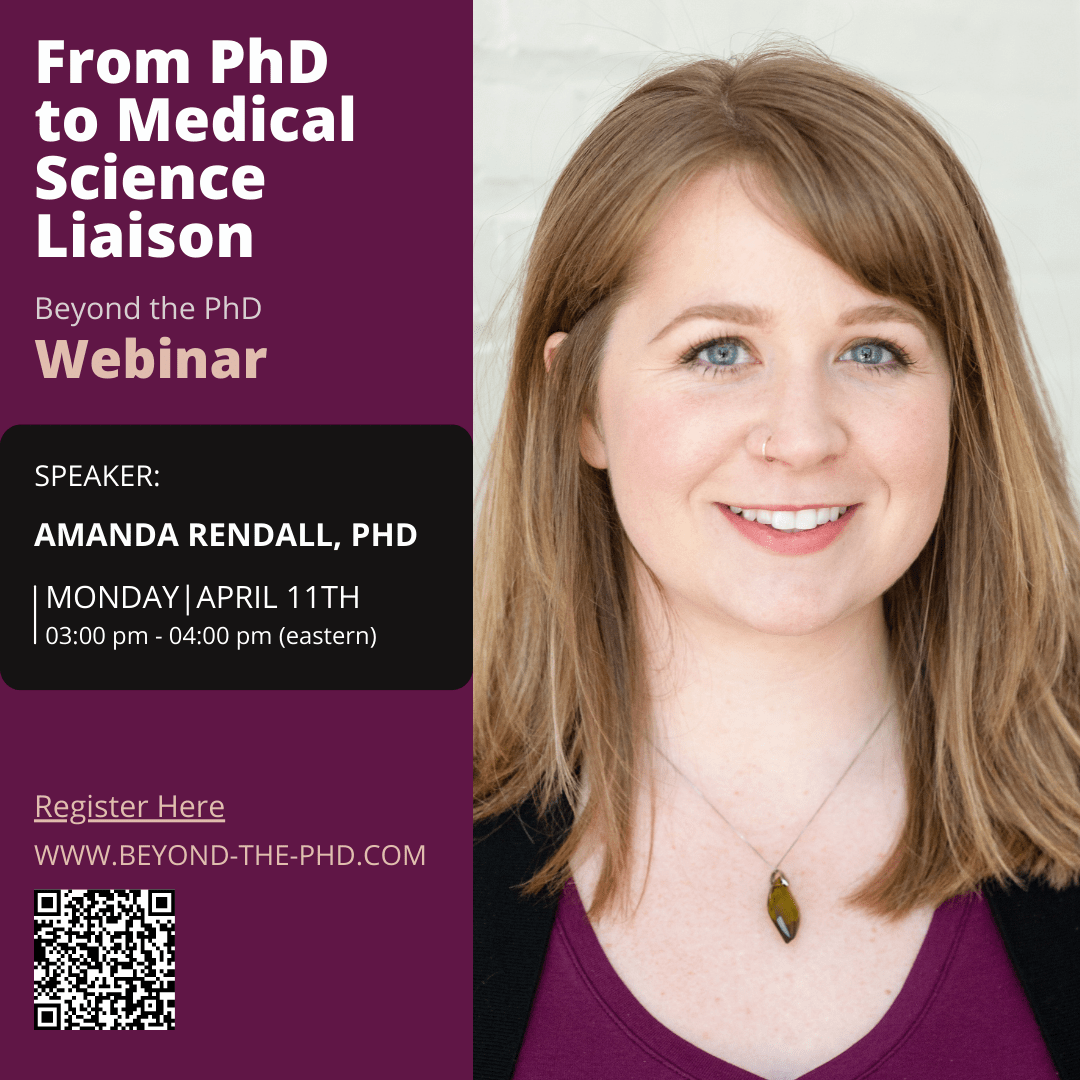
Do you have a passion for teaching and enjoy finding new ways to effectively communicate scientific ideas to the public? If so, a career as a Medical Science Liason (MSL) may be perfect for you. This past month, Beyond the PhD had the pleasure of hosting Dr. Amanda Rendall, an MSL affiliated with AbbVie pharmaceuticals who specializes in therapeutics designed to treat migraines. One of her primary responsibilities is meeting with headache specialists to discuss the latest therapies and drugs available on the market. Prior to entering the field, she contemplated the idea of becoming a professor after obtaining her Bachelors from Stony Brook University. However, she soon realized there were other avenues she wished to pursue instead. Following graduation, she obtained a position as a postdoc in Data Science, but once again discovered that this was not her true passion. Being newly married and looking to start a family, she was interested in a career that would be both exciting and challenging, but also provide her with some flexibility in terms of scheduling. As luck would have it, a quick google search for “What to do with my PhD” resulted in her discovery of the MSL field. It checked off every box in terms of her desire to teach and  communicate science to others as well as be involved with the dissemination of information that would help clinicians decide on appropriate therapies for treating diseases. According to Amanda, MSLs act as a bridge between healthcare companies and the physicians responsible for treating a particular disease. They can be found in biotech companies as well as pharmaceutical and medical device organizations. Some of Amanda’s main responsibilities as an MSL entail delivering scientific presentations, identifying and training speakers, supporting advisory boards and participating in investigator-led research. She also assists with the coordination of company sponsored research and trials. The thing she loves most about being an MSL is that she is at the forefront of clinical research, where she truly gets to make a difference in the lives of patients. 

For individuals interested in pursuing a career as an MSL, a Postdoc position is not required, however it definitely gives you more credibility in the field. Previous experiences that helped leverage her current position involved participation in outreach and community activities as well as teaching undergraduate and graduate students during her academic career. She also stressed that it is a necessity to have a strong scientific background so that you are able to explain how certain drug therapies affect the body. Amanda also gave some insightful information on what the Interview Process for an MSL looks like. The first stage involves a series of phone screens/video calls with the recruiter/talent acquisition, hiring manager and sometimes other MSLs who serve as directors. The second stage consists of an in person interview, followed by a series of one on ones and the delivery of a presentation. Finally, if offered a position, her best piece of advice is to know your worth. Salary negotiation is key and Glassdoor/MSL surveys can be used as resources to determine how much MSLs within the area are being paid.

One of the difficulties associated with becoming an MSL is that it is a highly competitive field, however, the compensation and benefits are excellent and there are plenty of opportunities to work from home where you can set your own schedule. Although it can be unpredictable at times in terms of when you need to be available for clients and some travel is expected, the work is rewarding and allows you to have a positive impact on treatment selection by clinicians. Some of the helpful tips Amanda provided for breaking into the field include participating in network-informational interview/conferences as well as making sure to keep your resume updated. She also stated that it’s an excellent idea to connect with recruiters on Linkedin that assist with the placement of MSLs in companies such as SEM Bio, TMAC, Syneos, Trinet pharma etc. If you are interested to know more about obtaining a career as an MSL you can contact Amanda at (need her email address).  

PhD Student Perspective: The Sunk Costs of a PhD

Written by Dominique Martin

Finishing up the third year of a dual PhD/MBA, I find myself reflecting more often on the decisions and life events that brought me here. I am both astonished that I made it this far and dreading the fact that I still have a few more years of graduate school to go. It’s becoming harder and harder to explain to my family why I still have homework at 27 years old or why I don’t have a “real” job. Being a graduate student and seeing your peers and friends moving on with their lives can be difficult, and I find myself envious of those with more established careers and more settled lives. 

In one of my MBA classes, I learned about the sunk cost effect, a phenomenon that hit a little too close to home. The sunk cost effect describes people’s tendency to follow through on an endeavor (such as a PhD) if they have already invested time, effort, or money into it, even when the current costs outweigh the benefits. As a third year PhD candidate, I realize how much the sunk cost effect has impacted my decision to not only pursue but stick out grad school. All the costs and sacrifices that went into graduate school come to mind, and I often wonder if it’s all worth it. 

My path to a PhD was not exactly linear. I started out as a naïve undergrad convinced that I wanted to go to vet school. However, after interning with a few vets, realizing that vet school was not the path for me, and deciding I did not want to bury myself in $200,000 of debt, I was left unsure about my future. During my junior year of undergrad, I became involved in research and realized I enjoyed the lab work and research environment. Unsure of what I wanted to do next, I approached my undergraduate research mentor early in my senior year asking for advice. She knew about my decision to give up my dream of becoming a vet and instead offered me the opportunity to stay as a master’s student in her lab.

I went straight into a master’s after undergrad, not really looking into other programs or considering a PhD. During my time as a master’s student I was offered the chance to convert to a PhD track. I turned this opportunity down for a variety of reasons including not being in love with the project as well as worrying that doing all my degrees in the same lab would hinder my career choices going forward. Instead, I chose to complete the master’s in Animal Science and take a year to work in as a lab manager before deciding to go back and get a PhD. When applying to PhD programs I transitioned away from Animal Science and applied to Biomedical Science programs, wanting to focus on more translational research. 

Now, three years into a PhD in Biomedical Science, I often wonder if I made the right decision when I decided to not convert my master’s. I would have already been done with both degrees and in the beginning stages of a career. At the start of my PhD, I was told by my program that having a master’s would cut down the number of classes I had to take and make my time to graduation shorter. Unfortunately, this is not the case. If anything, I took more courses than needed and my time to completion has not been impacted at all. Although I got valuable training during my master’s that made the transition into a PhD program seamless, I think about the sunk costs of deciding to tack on another degree. 

Graduate school has been a time of immense growth for me, and with that comes growing pains. Not only did I switch fields, I joined an immunology lab despite having little experience in the subject. I love the lab I’m in and am passionate about translational aging immunology research. However, switching research fields so drastically definitely made things harder, and on top of that I pursued a dual MBA. I still am playing catch up and often have bouts of imposter syndrome, questioning if I’m truly cut out for this field. I’m also facing many of the challenges grad students have to deal with on a daily basis such as financial insecurity, department politics, failed experiments, and wondering when I will actually be finished with my degree. I’ve put years into this program and sometimes question if it was worth the effort, sacrifice, and sunk costs. 

Despite the sunk costs of graduate school, I appreciate all that I’ve gained. I’ve gained independence as a researcher, a group of peers and mentors, and invaluable training. My research interests definitely took a pivot, but that has made me a more well-rounded scientist. Although the path has been filled with challenges, setbacks, and hurdles, I have learned and grown along the way. Even knowing there are a few more years to go, I look forward to sticking this out, sinking in some more time, and seeing where the journey takes me. 

From PhD to Clinical Research Coordinator

Recently, Beyond the PhD hosted Dr. Hank Hrdlicka to  share his career path to becoming a Certified Clinical Research Coordinator at Gaylord Specialty Healthcare’s Milne Institute for Healthcare Innovation in Wallingford, CT. Hank started by giving some background on his educational and career journey. He is originally from Wahoo, Nebraska and attended Nebraska Wesleyan University where he earned a B.S. in Biochemistry and Molecular Biology. He was a Nebraska INBRE research scholar which allowed him to complete a two-year paid research internship and also served as the president of the Graduate School Club for three years. Hank knew that he wanted to go to graduate school and joined the UConn Health Biomedical Science PhD program in the fall of 2014. After completing his three rotations, he joined the lab of Dr. Anne Delaney in the Skeletal Biology and Regeneration area of concentration and graduated with his PhD in 2020. 

In addition to the technical skills gained during his PhD, Hank shared some of the lessons learned during graduate school. First, he relayed to the audience that you should focus more on the mentor rather than the research. The mentor needs to be someone you will work well with and will help you grow. He also emphasized to prioritize your mental health during graduate school. It’s important to remember that your self-worth is not defined by your results and that maintaining a work life balance is important both during graduate school and after. He also talked about building transferrable skills while in grad school and how these skills are invaluable when job hunting. These can be skills such as communication, writing, project management, organization, task prioritization, problem solving, mentoring, Microsoft Office familiarity, and the ability to use statistics programs.

Hank then went on to talk about starting his career search after graduate school. He sought out careers that built upon his particular strengths and interests. He also contacted the UConn Career Center to help with his resume, CV, and cover letters. When applying for jobs he used platforms such as LinkedIn, Indeed, HigherEdJobs.com, The Chronicle of Higher Education, and the State of CT job forums. Hank then went on to discuss interviewing. He suggested that even if you don’t think you will take the job, it never hurts to interview. This can help you get comfortable with the interview process and find strategies that work for you. It is also important to do your homework on the company you are interviewing with. Hank said that finding a position took him about 10 months and that he submitted about 100 applications, demonstrating his resilience and persistence. Next, Hank relayed some lessons he learned from his job hunting experience. He suggested that if you want to shift away from academic or industry research to start planning and applying early. Additionally, take comfort in the fact that bench research can always be a backup. He noted that while some people benefit from networking and connections, others may simply need perseverance to find the right job. 

Hank then went on to discuss his current position as a Clinical Research Coordinator at Gaylord Specialty Healthcare’s Milne Institute for Healthcare Innovation. The Milne Institute is anchored by Gaylord Hospital, a long-term acute care hospital in Wallingford, CT. This hospital is widely recognized for treating and rehabilitating patients experiencing spinal cord and traumatic brain injuries, acute and post-acute COVID-19, as well as pulmonary, cardiac, amputee, stroke, and other medically complex conditions. Hank’s role as a Clinical Research Coordinator involves breaking down the barriers to make research more approachable and less intimidating for those with limited prior experience but lots of enthusiasm for research. He often works with other health care workers such as nurses, physical and occupational therapists, and speech therapists. He is involved in facilitating all stages of research such as study conception, preparation of IRB application, recruitment and data collection, data analysis, and manuscript preparation. He is also involved with developing and promoting staff education on good research practices. Hank has been at his current position for a year and a half. During that time Hank has helped increase the number of research studies from a yearly average of 6-8 to a current count of 14 IRB approved and 60 studies overall. He is personally involved in 26-30 studies, has published 3 manuscripts with a fourth under review, and had helped established national and regional collaborations. He has also completed a certification course to become a Certified Clinical Research Coordinator.  Hank’s technical and transferrable skills gained during his PhD have been extremely helpful for this position, but he has also been able to learn and grown now that he has transitioned out of academia.

If you missed Hank’s seminar, but would like to view it virtually to see what you missed, check out the video on our YouTube Channel here, https://www.youtube.com/watch?v=vI3lnLJxIRg.

Visit our seminar recordings page for other recordings of events.

The Non-Linear Path of a Graduate Student

This article contains the personal experiences of Dr. Brittany Knight. Opinions are her own.

The Beyond the PhD team started writing reflection pieces this year to provide our readers with personal insights to our career journeys as early career professionals. I encourage our team to be honest as we all can relate to each other in one form or another. Below is my honest recollection of my journey from my undergraduate training through my graduate school training, and to my current role as Program Coordinator of the United States Association for the Study of Pain, the United States Chapter of the International Association for the Study of Pain.  

First Things First, Looking Back 

Reflection is a tricky thing. It takes honest and calm introspection. And if you’ve been through life, as you all have unless you are artificial intelligence (please no spamming!), you know it comes with its ups and downs and our career journeys are not linear. My career journey is by no means linear. 

For context, it has been nearly 3 years since I stood in front of my peers to deliver my dissertation defense, eight years since I prepared to move from Pennsylvania to Connecticut to pursue my graduate training, and almost, dare I say, twelve years since I was infected with the idea of wanting to pursue research as a career. My mother would tell you I was 1 week into college, and I was already researching graduate programs. I had universities from all over the country mail me whatever free materials they had about graduate programs. I guess this was before the true internet age set-in and everything was provided digitally … I can honestly admit I wasn’t sure what I wanted to study; at the time I was pursuing a B.S. in Psychology at my undergraduate institution, but I did know I wanted to know more than college could offer me. 

Undergrade to Graduate Transitions 

Fast forward four years of courses in psychology and biology, four independent research semester projects, and a summer internship to the “deep south” studying marine mammals in Gulfport, Mississippi. In the Spring of 2013, I was rejected from every graduate program I applied to study animal behavior. I was devastated. I had no back up plan. There was only one plan. And I was determined to see it through. I can remember sitting in the Ulmer Sciences Building on my undergraduate campus, Lock Haven University of Pennsylvania, in the study lounge the week before graduation and deciding I was not ready to leave. I knew I had some gaps in my training that I would need to fill before pursuing a second round of graduate school applications. I re-enrolled myself for fall 2013 courses with the goal of completing a 1-yr post-baccalaureate program in Biology. My plan was to apply to graduate school a second time but this time I would take off my gloves and apply for what my heart really wanted, to study neuroscience. I was fascinated by the neurochemistry of the brain and the behavior that resulted from it. This is why I chose to study psychology. I wasn’t interested in counseling like most of my classmates, but instead I wanted to understand the why or physiology being psychological processes; how chemicals in the brain produce our thoughts, feelings, and behaviors. One year and several chemistry courses later I stepped onto UConn’s Health’s campus in Farmington Connecticut the Fall of 2014 as a Biomedical Sciences pre-doctoral candidate. I recall feeling overwhelmed, excited, and extremely motivated to learn all I could. 

Graduate School- the True Test

But as I mentioned and as we all know life has its ups and downs. Any graduate student if they are being honest will admit to you that their program was no walk in the park and … they likely thought about quitting. I didn’t ever conceive myself quitting my program, but I was tested constantly over my five years of training. On a personal note, I lost four family members in my first year of graduate school, including all my remaining grandparents, and during my second year my mother was diagnosed with breast cancer. In the laboratory, my lab’s Principal Investigator was new faculty (just started their lab at UConn the year before I joined their lab) so we were starting a mouse colony and all new projects which had its own unique set of challenges and frustrations. I’ll be honest I felt alone, I struggled, and I cried a lot. But between those hard days I also experienced elation planning my experiments, collecting new data, working late with lab mates, and walking those empty hallways in the early am or late pm felt like magic. The halls seemed to buzz from the day or the day to come. New data. New discoveries. Progress. Discovery! That magic with a lot of support from my friends enabled me to pursue a postdoctoral fellowship. I wasn’t sure what I wanted to do yet. And after speaking with a mentor from college I was convinced a postdoctoral fellowship could give me the time to truly think about my future goals. Then COVID hit … and I was struck with the hard truth of academia. I had seen it before and knew it existed you just don’t expect it to be you. The training program I had my fellowship through was not renewed and I was faced with the problem of funding to keep my position. 

I started to think about new ways I could invent myself outside the pillars of academia. It was then I started giving informational interviews to professionals with positions in academic counseling, academic foundations, and industry. I had several interviews that mostly resulted in the discovery of what I did not want to do. But I wouldn’t have known otherwise. This is why Beyond the PhD was founded; to help students understand their career options beyond academia, to help them discover new ways to transfer their carefully learned skills and obtain new positions that give them fulfillment and a lifestyle they deserve. I owe my involvement with Beyond the PhD with the tools and confidence to look outside the walls of academia and see what greener pastures may lay ahead for me. 

Transitioning Out of Academia

One day, an announcement from my research community came to my inbox. The organization was looking for a Program Coordinator for the United States Association for the Study of Pain. This position entailed coordinating and working with the various working groups within the research community, planning the annual conference, and other community building activities and professional development events. I was part of this community for 6 years as a trainee. Now almost 9 months into the role I help with almost every facet of the organization.

My advice to anyone not knowing what their next step is, is to be persistent, persevere, and know you are not alone during your career journey. You have what it takes to get where you want to be. 

My vision for Beyond the PhD is to provide a community of graduate students that can network, share their experiences judgement free, support each other and lift each other up to achieve and pursue greatness. We are the next generation of scientists and leaders in our fields. And if you haven’t heard this today, know that you are doing amazing and you will get to where you want to be, just be patient and trust the process. 

Sai Nivedita Krishnan Personal Perspective

Sai Nivedita Krishnan

After spending most of my life in the city of Chennai, India, I moved out to the neighboring state of Kerala to begin my (what now seems never ending) academic journey in 2013. In a way, living in a state where I did not know the local language and eating food that looked vaguely familiar but tasted a world apart prepared me for my life abroad.

After completing my undergraduate program, I ended up in the University of Manitoba in Winnipeg, Canada where I had the pleasure of acquainting myself with the worst winter I had ever experienced. Armed with the thickest jacket and the bulkiest boots I could find, I started my Masters in Science (MSc) degree in Canada. I was lucky enough to secure fellowships from Mitacs and Research Manitoba to fund most of my research stipend for two consecutive years. I also participated in a roundtable discussion with the Honourable Ian Wishart, who was then the Minister of Education, Government of Manitoba in 2018 to discuss my experience as a Mitacs Globalink graduate fellow at the University of Manitoba. In the last year of my MSc program, I carefully weighed the pros and cons of staying in Canada to complete my PhD in biomedical sciences, but eventually decided to apply to schools in the United States because I liked the flexibility of rotating through different biomedical labs that many US graduate programs offered to first year PhD students. I ultimately decided to join the Biomedical Sciences PhD Program at the University of Connecticut Health campus in Farmington, CT.

Unfortunately, I had to defer my start date by one year due to the complications of travel during the COVID-19 pandemic in 2020. I remember being severely disappointed that I was losing a year of my graduate training because I had already submitted my thesis and was on track to defend in the first week of August 2020. Ultimately, due to air travel restrictions, I could not fly home after my thesis defense and had to defer my graduation too until January 2021. So, I had to remain in Canada and continue my research in my master’s thesis lab. In October 2020, a few days after my mother’s birthday, she was diagnosed with breast cancer, and I could not fly back to be with her during her surgery or to help her during her chemotherapy sessions. Working in the lab served as a welcome distraction but it was very hard to fight the warring emotions of guilt and despair.  I eventually was able to secure flights to travel to Chennai in January 2021 before her last chemotherapy cycle and spent almost six months with her during her post-chemo recovery. It was ironic that what I had perceived as one of the biggest disappointments in the first half of the year, the deferral of my PhD program, turned out to be a gift in disguise so that I could be with my family during that challenging time.