Featured

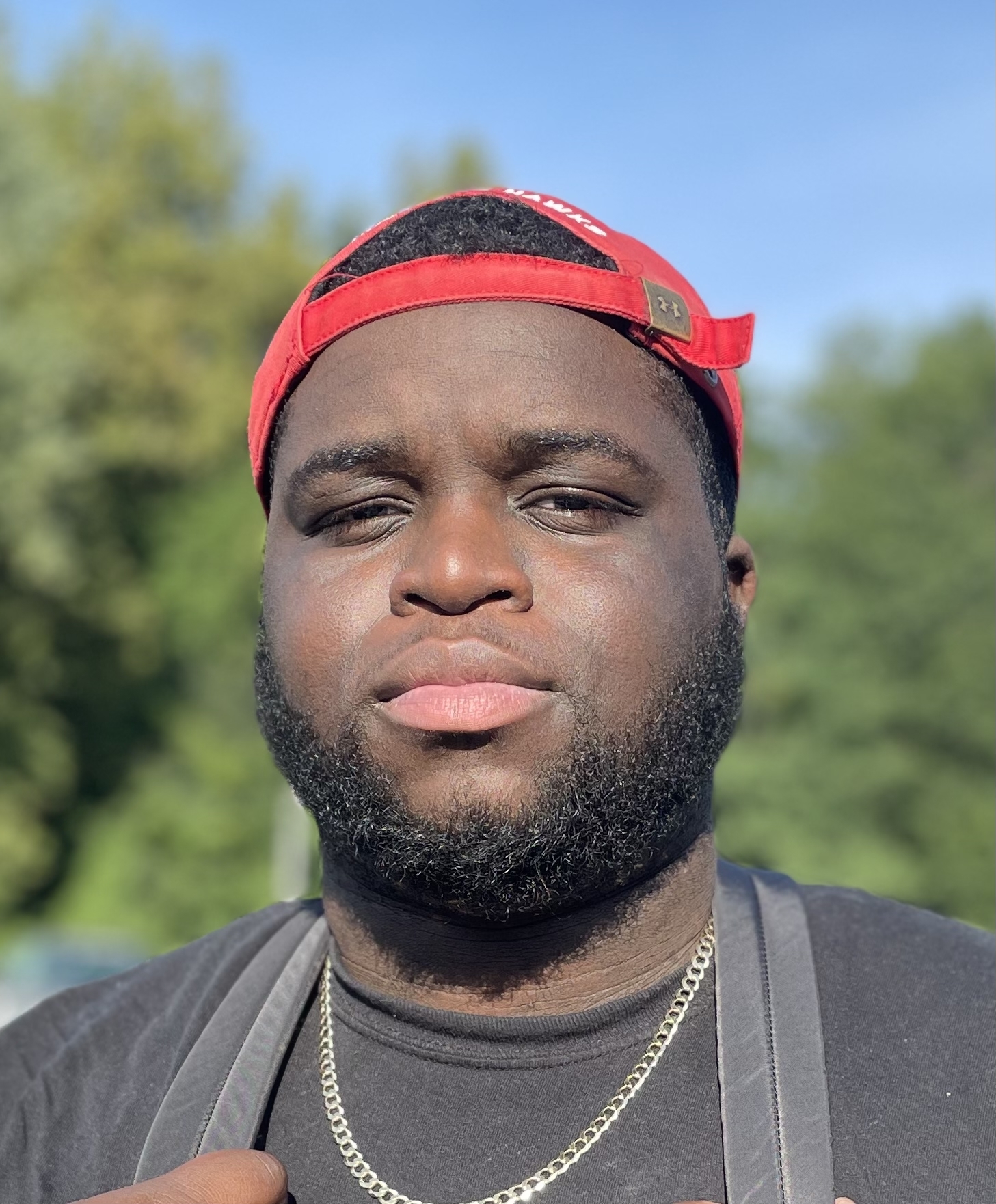
Meet Jaden Spring 2022 Campus Ambassador

Jaden Richardson is a junior at the University of Hartford studying biology and pre- pharmacy. He graduated from Freeport high school in NY in 2019.

While writing this piece, I stopped to reflect on what keeps me going and why I wanted to be a part of the medical field, specifically pharmacy. Being the oldest of three and the protector of my little brothers, compassion and my constant desire to help others was almost innate .

Growing up, my first dream job was definitely to be an astronaut. The thought of space’s vastness and striving tounlock its limitless bounds was something that always intrigued me. Similarly to my fascination with space, the unknown aspects of the study of medicine and biological sciences is what mostly intrigues me about the field.

In the third grade is where my big shift from astronomy to my love of medicine came to fruition. My third-grade teacher at the time was a person who took the study of animals very seriously. The class at the time had a turtle named Benji. Benji was a very interesting turtle in that he had a large abscess on the side of his face. Throughout the school year, all my classmates would take turns feeding him and giving him his medicine. Now, at the time none of us knew what the medicine was for but we still willingly gave it to him in order to help .This was a pivotal point for me in that it subconsciously made me more interested in different types of treatments out there andtheir effects on living things. My turn came towards the end of the year and the week I was feeding him, his infection was almost completely gone. The whole class cheered and I was seen to be the hero of the year for saving Benji. From then on, I knew I wanted to work with medicine and save others like Benji. This way of playing doctor evencontinued at home and to this day. When anyone in my family gets sick, I’m the first one everyone goes to for help.

As my education furthered, my love for science continued to grow. I took more science classes in order to learn as much as I could and it became like an obsession to me. Being as competitive as I am, in high school I began taking part in science fairs and outside research. This influenced my decision to come to college in hope thatI can continue my passion.

Currently, I am an undergraduate junior at the University of Hartford as a biology, pre-pharmacy major.The deciding factor for me in going this route was when I had a

conversation with a family member who is recently new to the field. His overall passion for the impact he was making on his patients on a daily basis inspired me to want the same career. I’ve envisioned working in a hospitalbecause that’s where I believe some of the best work is done in this field.

Therefore, as an aspiring pharmacist, something I hope to accomplish or gain out of this career path is totruly impact people’s lives through medicine and science.

-Written by Jaden Richardson

Featured

Meet Mariangelie Spring 2022 Campus Ambassador

This Spring Mariangelie Beaudry was selected to participate in Beyond the PhD’s Campus Ambassador Program. She graduated from Agawam High School in Agawam, MA in 2019 and currently is a a junior at the University of Hartford studying biology.

The earliest age that I can remember wanting to be a part of the medical field was at the age of eleven in my health class where we learned basic anatomy. I was fascinated by everything that I learned and had looked forward to that class every week. Keeping in mind that my love for the sciences was growing, the following year my grandmother was diagnosed with pancreatic cancer. 

Once she had been diagnosed, I began to ask lots of questions about the types of things she was going through. I was curious about the symptoms she was experiencing, the treatments she was receiving, and in what ways it was also affecting all of my family members. As time had progressed, I had noticed that there was not a lot of awareness about pancreatic cancer and it was not talked about enough. As a twelve-year-old, I went to my town hall and met with the mayor to see in what ways I could make a difference and bring more awareness to pancreatic cancer. After a couple of meetings, I was able to work with the mayor and declare November as Pancreatic Cancer Awareness month in my town. I was really proud of the awareness that I was able to spread for my grandma before she passed away. 

In the following years, I continued to follow my passions with biology and other sciences in high school. In the back of my mind, I was always thinking about the more knowledge I could have to better understand the body and what my grandma had experienced. Afterward, I was also thinking about the effects of cancer in my family line and how that plays a role in genetics. In my senior year of high school, I had the opportunity of going back to the junior high school I had attended and working with my teacher that had taught me science in seventh grade. I loved that I had come full circle and was able to help students at that age with labs and provide any guidance that I could from my perspective. 

Now, currently a junior at the University of Hartford, I realize even more how much I enjoy working with people and being able to provide advice from my point of view and the knowledge that I have. I am currently a biology major and have been enjoying all of my science classes thus far. On campus, I have had more opportunities to work with people such as being a tour guide where I am able to guide prospective students around campus and give them an insight into campus life as well as specialize in the biology labs. On top of that, I am an orientation leader where I get the opportunity to help the incoming first-year class get acclimated to being on a university campus and get some of those first-day jitters out. Lastly, I am a member of the student government association where I get to work with other students and be an advocate of the student’s voices. I enjoy that club especially because it allows me to bring to life my other hobbies in politics that I do not give as much attention to sometimes. 

Currently, I am planning on going into a program after graduation where I can work with people, teaching them about genetic disorders that could potentially affect them in their lifetime and in what ways they can cope with it. I am aspiring to educate people and positively impact their lives. I am hopeful that I can help as many families as possible and I am very excited to see where else my journey takes me. 

Written by Mariangelie Beaudry

Featured

Dr. Fiona Watts- Insights into the Importance of Scientific Communication

In March of 2021, AIOG had the pleasure of hosting Dr. Fiona Watts who is a Director for Stem Cells and Regenerative Medicine at Kings College London. She also happens to serve as the Executive Chair of the Medical Research Council in the UK. Dr. Watt’s research focuses on the interplay between internal and external factors in the regulation of stem cell fate.

In the Spring she spoke on the many scenarios that she uses her expertise in scientific communication to increase the accessibility of science to the public. I was particularly drawn to this talk, as I am always looking for ways to improve how I communicate my research to colleagues and friends. In the past, she has helped to communicate scientific goals and ideas through non-profit organizations such as Versus Arthritis, as well as government agencies seeking advice about the use of human embryonic stem cells. She also described her collaborations with artistic communities to present science in new and exciting ways, which I thought was a particularly innovative approach to increase the accessibility of science to all ages.

As the Director for Stem Cells and Regenerative Medicine at Kings College London, Dr. Watts participates in several projects that aim to make basic research fun and inspiring to students of all ages. She promotes public engagement in science through social media avenues (wattlab | home) ,a seminar series called “Stem Cells at Lunch” that encourages colleagues to come together and discuss their work, and she even has a YouTube channel (Watt Lab 1) designed to help scientists improve their communication skills.

In this talk with Beyond the PhD (AIOG), Dr. Watts emphasized the importance of communicating science to the public through networking, which will provide researchers the opportunity to learn new skills and improve how they present their work to the public. She also provides excellent advice on best methods to target your audience including using language that is both collaborative and respectful of audiences without expert level knowledge of science.  Overall, this talk is beneficial for anyone interested in pursuing a career in scientific communication or those seeking better ways to present their research in a broader, more relatable context. 

To listen to the full interview with Dr. Watts search under the “Interviews and Recordings” section of the website for “The Importance of Scientific Communication with Fiona Watts”.  

Featured

A Reflection: Exploring AIOG’s History and Celebrating our Victories

Nearly three years ago, started with their inaugural networking event to help students and postdocs connect with professionals. While some universities have formal programs to showcase the various careers students can pursue in STEM, founders Giulia Vigone and Robert Pijewski thought their colleagues at UConn would also benefit from such a program. With the assistance and mentorship of Dr. Vaibhav Saini and Giulia Vigone, treasurer of the postdoc association, developed a program that could foster career development for graduate and postdoctoral students at UConn and other universities in the Greater Hartford area. This program became what is now known as AIOG. The goal of AIOG is to both inform students of careers beyond just academics as well as careers in STEM that don’t necessarily require a graduate degree. The hope was that if we could get 4 or 5 students to each seminar, then we would be helping educate the student and postdoc population.

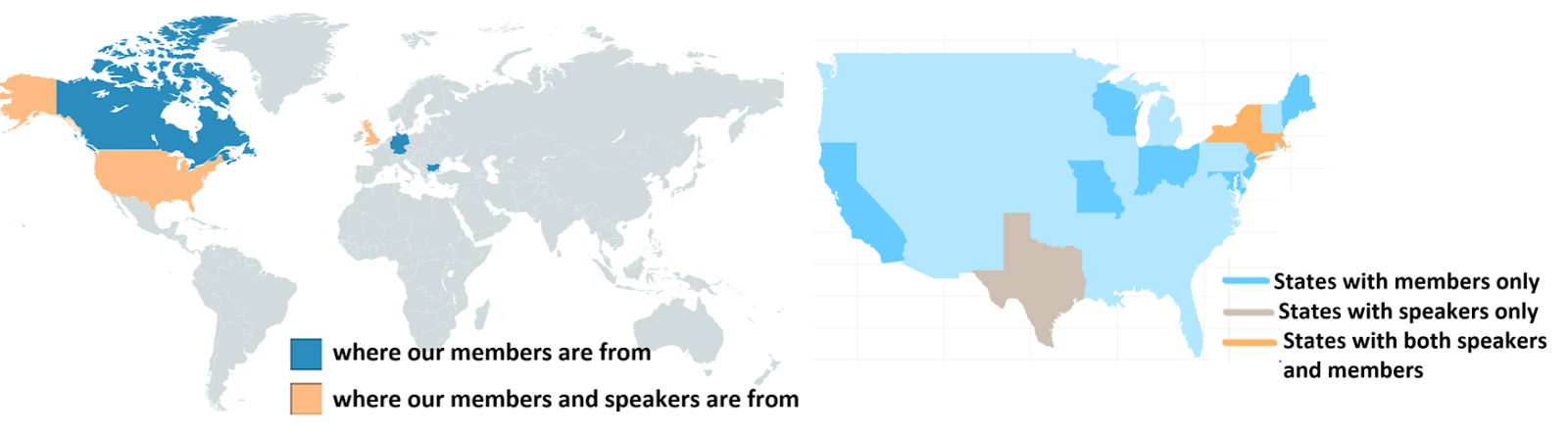
Like most things, the Covid-19 pandemic changed the way we had to approach networking and educating our audience of young STEM professionals. To rise to the challenge AIOG adopted an online format with Zoom seminars and an online networking event. With the increased flexibility of using Zoom, we were able to host and invite speakers from around the globe, as well as reach students and postdocs around the world from other universities (geographic schematic below). We were also able to grow our team to include scientists at other universities. To date, we’ve had over 400 unique individuals join us from around the globe. 

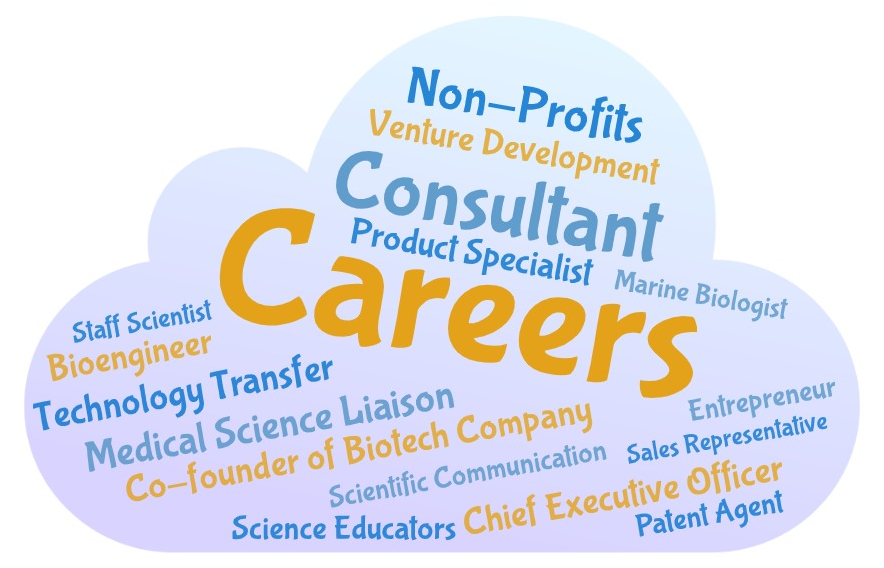
Over the past 12 months we have also utilized our website more to provide resources for students. The website features scientist interviews, video interviews through our youtube channel, and editorial articles about our events to help educate students about the spectrum of potential careers (see word cloud below of a summary of careers) they can use their transferable skills learned throughout their scientific training. We have also adopted a name-change Beyond the PhD to promote our brand on social media outlets including twitter, facebook, and linkedIn. We hope this re-branding will help AIOG reach more students furthering our impact.  

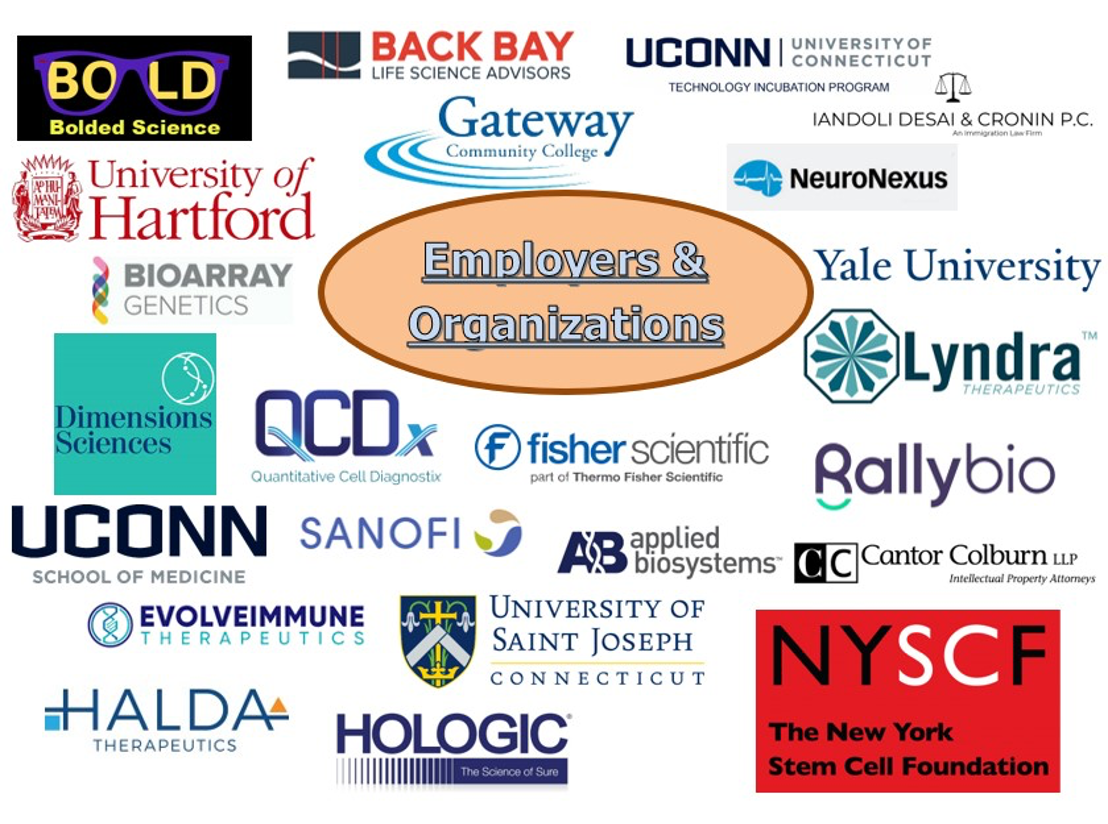
Compared to our first networking event that featured 12 industry guests and over 35 students and postdocs, our third networking event that was held about a month ago featured 25 professionals and hosted over 70 students. This event was made possible through partnerships with Dimensions Sciences (DS) a nonprofit organization and their science outreach program DS-CAMPUS. Moving forward we plan to continue to collaborate with organizations that share our vision, to share our resources and thus expanding our network of careers and professionals that our student-base may have access to. See below for names of organizations we have hosted or interviewed. In the future, we would like to create a mentoring program that matches students with professionals. 

For Fall 2021, we are organizing an Ambassador program for students on their campuses across the United States. This program will provide a platform for college upperclassmen and graduate students to lead discussion, help organize events, and disseminate information about AIOG hosted events that aim to educate their peers about careers in STEM. Stay-tuned for more information on how you can become an Ambassador on your campus this coming Fall. 

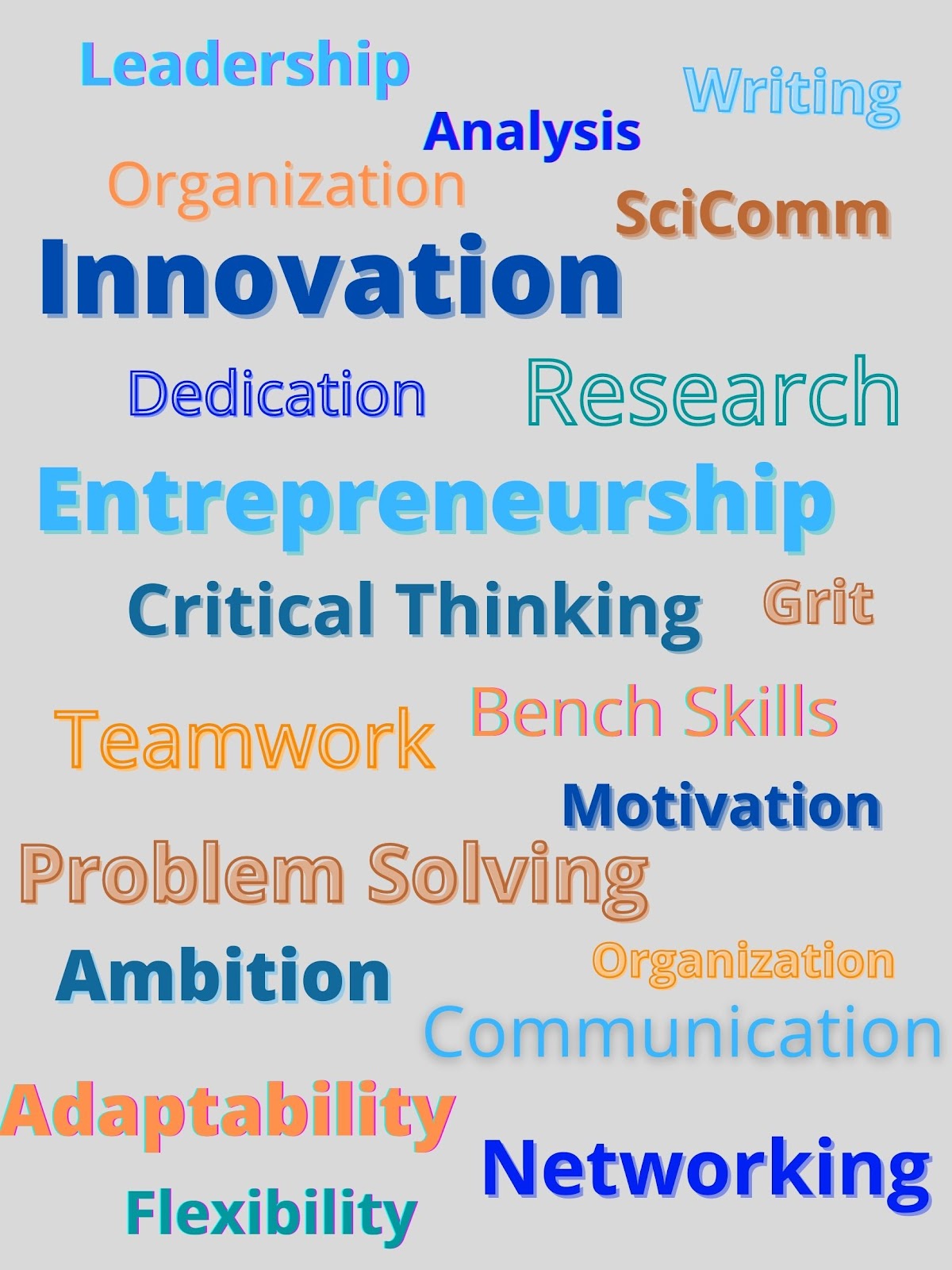
The success of AIOG’s events has demonstrated a prominent interest in learning and networking with scientific professionals in and outside of academia among the upcoming generation of STEM professionals. Looking back, we at AIOG are beyond excited to have hosted a myriad of career topics. It is hard to think back to all the advice these guests have given, but many themes remain prominent (themes represented above). Some themes that have been referenced in all of our seminars is being a team player, being a critical thinker, and being able to adapt. 

Written by Rob Pijewski and Britt Knight

Special thanks to the entirety of the AIOG Team for organizing and making the schematics and graphs for this article.

Featured

Interviewing Kerry Silva: Creator of Bolded Science

Have you ever gotten tongue-tied trying to explain your research project to your parents? Or heard a scientific talk that was more acronyms than explanations? Well you’re not alone- we all have! Scientists have a way of talking to each other with each field having its own specific jargon, and that’s great because we need that when we’re in scientific spaces, but it’s not very helpful when grandma asks what we do every day. That’s where SciComm comes in. SciComm, which is short for Science Communication is an emerging field that gives spaces for scientists to explain their work in a way that is understandable to everyone, regardless of their prior knowledge on the subject. SciComm is unique and serves a major role in society because it encourages open communication between scientists and the rest of the world so everybody can understand the science that affects our lives and drives our scientific advancements.  

To get an insider perspective, we interviewed Kerry Silva McPherson, a PhD candidate studying molecular biology and biochemistry and an active member of the SciComm community on how she got into SciComm and what she hopes to gain from it. Last year Kerry created Bolded Science, a collaborative blog that gives scientists of all career stages a voice and a chance to practice writing for a non-scientific audience. On Bolded Science grad students, research technicians, or undergrads can write about their research, a scientific topic of interest to them, or even about life as a scientist to get published on the site. What a great way to get your writing out there! Plus, it can help other researchers and non-researchers better understand your topic. SciComm is an all- around win-win! Bolded Science has published several blog posts on topics like what a porosome is, the Covid-19 pandemic, and racism in science.  

SciComm can become its own career by monetizing blogs, vlogs, or working for a company or it can provide skills heavily emphasized in other roles such as in science policy or medical affairs. It can also be a fun hobby that lets people outside of science see into our little world. SciComm can take any form of communication: from podcasts and video to blogging and art. Anything that turns science from heavy with jargon to light and enjoyable is SciComm. The SciComm mission is simply to make science more accessible to all and show that science isn’t scary. So if you’re currently a scientist, ditch the alphabet soup sometime and try your hand at writing for a general audience. If you’re not a scientist- check out some science blogs and who knows what you may find. Just remember, behind every brilliant scientific discovery there’s the dumb questions we had to ask to reach it. There’s no shame in not knowing and we all have to start somewhere.

So here’s an idea- start with checking out Bolded Science! If you’re interested in writing for Bolded Science or just super into science, head to www.BoldedScience.com and check it out! 

Watch the full interview on our ‘Recorded events and interviews’ page.

Written by Christina R Miles Graduate Assistant

Biomedical Sciences PhD Program| UConn Health 

Featured

45th Connecticut Academy of Science and Engineering meeting

Recently, the Connecticut Academy of Science and Engineering (CASE) held their 45th annual meeting online. CASE is a non-profit institution that is patterned after the National Academy of Sciences. The institution identifies and studies issues and technological advancements that are of concern to the state of Connecticut. Since the founding of CASE in 1976, the academy has fostered an environment that promotes collegial collaboration and support through the   encouragement of scientific and technological creativity. The theme of meeting was innovation. Although the Covid-19 pandemic has slowed a lot of scientific research, CASE has been involved with the state providing vital research and guidance to promoting Connecticut’s success through the pandemic.

Nick Donofrio , the former vice president of innovation and technology for IBM, and David Ferruci of Elemental Cognition co-presented the keynote address. Nick Donofrio gave great insight on what is needed to be an innovator. Many scientists and engineers seek the answer and find the problem that the answer can be used for, however, Donofrio advised against this. Instead, he suggested that the individual or team must be intimate with the problem; to be a successful innovator, you must know the problem. It is better to start with a problem, rather than an answer for the problem. Ask questions, engage, and most importantly, listen. His words on innovation are not only applicable to the Covid-19 pandemic, but in Donofrio’s words, “the second pandemic of racism in this country”. To truly be collaborative, the team must be inclusive and diverse. No one person will have the answers to everything, and the more perspective you have the better understanding you will gain of the problem and how best to solve the problem. David Ferruci, followed with a presentation about his journey as an innovator. David Ferruci has worked in the field of Artificial Intelligence (AI) for over 25 years. He was the lead on IBM’s Watson project and now, he has his own company Elemental Cognition. David first got interested in AI during a computer programming class where he learned the power of programming and executing commands. He envisioned that this computational control would benefit the world. Starting with a simple command, could he program a computer to answer open-domain questions (i.e. Jeoprady). To create AI that could succeed in open-domain questions had a massive impact potential. Yet, accomplishing this goal could also have substantial risk. Ferruci felt that even though this monumental task had risk, stagnation would feel far worse. Long story short, his AI became the best question-answering AI in history. IBM’s Watson defeated all human contestants on the show Jeopardy. Ferruci said that the Watson project led to 1000s of additional research projects and papers came out of this AI milestone, hundreds of invited talks, billions of impressions, and it led to large scale commercialization efforts at IBM and elsewhere. More importantly, this AI project helped reimagine the art of the possible in AI. Thirty plus years later, David is still inspired from his original work on Watson, and has created a company that is trying to solve the problem in making robots understand things ( I need a better word). Dave was additionally one of the 36 newly inducted members into the academy that evening. 

To learn more about the Connecticut Academy of Science and Engineering, visit their website at www.ctcase.org. To learn more about IBM’s Watson project, view the full story here https://www.aaai.org/Magazine/Watson/watson.php

Featured

Smart Tribe: A New Way to Network

This July, I interviewed Beatrice Zatorska, the co-founder and CEO of Smart Tribe. Beatrice is based in London, but Smart Tribe is a global platform that has users from multiple countries.  Smart Tribe is a new online platform that helps connect individuals in academia and industry professionals. The goal of Smart Tribe is to unleash science by matching talent and technology. By making connections between different individuals, Smart Tribe can help with networking, problem solving, job hunting, academic and industry partnerships, launching new technologies, and more. 

Can you tell me about yourself and why you started Smart Tribe? 

Beatrice co-founded Smart Tribe with Kris Jack. Although they have different backgrounds, they represent both the academics and industry professionals that are using their new platform. Beatrice has 20 years in industry working as a management consultant. She specialized in working with emerging technologies which often came from scientific research. Kris represents the academic side and holds a PhD in computer science. He previously worked as the chief data scientist for Mendeley and Elsevier. 

Beatrice and Kris started Smart Tribe to bring together people from different backgrounds and ultimately offer a way to find unique solutions to new problems. Original and outside perspectives from either academia or industry can be extremely beneficial when launching a new project, networking, or developing novel tech. Smart Tribe connects users from across the globe using a specifically designed AI that matches people based on their goals and interests. 

Together, Beatrice and Kris developed Smart Tribe to foster communication and collaboration between those in academia and people working in different industry sectors. Their goal is to unleash science, solve problems, and better the world by making meaningful connections.

What is Smart Tribe and how does Smart Tribe work?

Smart Tribe is an online platform which makes smart introductions between academics and industry personnel. People from either sector can join and create a free profile at https://smarttribe.io/. As a user, you can create a bio and share your goals and needs. Each month you can elect to be connected with another user, and Smart Tribe uses an innovative AI to match you with a new connection. Smart Tribe allows you to connect with other users based off your interests. It can be used for networking, learning about different industries, problem solving, consulting, and more. 

What can Smart Tribe offer users? 

One of the benefits of Smart Tribe is that is has global reach. Currently, many academics and industry professionals work in silos, and their network is usually limited to others in their field. Additionally, their network is often geographically limited to those in their workplace or surrounding area. With Smart Tribe, people from across countries and continents can connect with each other and find a way to tap into the exciting science coming out of different sectors. 

One thing Smart Tribe can be used for is networking and job hunting. Currently, there are not enough academic jobs for the amount of PhDs academia produces. Smart Tribe is a useful tool for those PhDs looking to transition into industry. Most people find jobs through their network, so Smart Tribe can help academics increase their professional network. It is also a great tool for academics who want to learn more about different industry positions and roles. 

Smart Tribe can be useful for industry professionals looking for expert consultants or academic scientists. Industry personnel can find academic experts in specific topics, hire them as consultants, and build partnerships. Expert consultants can provide valuable skills and assist with different projects. With this platform, consultants can come from all over the globe from different fields. Academics can offer unique insight and guidance to different problems. Additionally, using Smart Tribe is a great way to tap into the exciting and novel science coming out of academia. People are no longer bound to their local networks, and can discover new science coming out of different parts of the world. 

On the other hand, academics may be able to find industry partners. This can help academics looking to find outside funding, commercialize tech, or launch new products. Scientists within the university setting may not have access to proper resources or have their own business or become entrepreneurs. They can use Smart Tribe to find industry professionals to assist them with things such as finding investors, launching new technology, management, and more. 

What are the goals of the company going forward?

Since Smart Tribe is a relatively new platform, it is still expanding. Each month, the platform grows by thousands of users from the Unites States, United Kingdom, Europe, and more. There will also be new features coming out in the near future. Going forward, the company wants to understand more about the interactions and connections taking place on Smart Tribe and what users are getting out of these. Additionally, Smart Tribe is putting out some free webinars on different topics such as the importance of social skills in industry and entrepreneurship. 

Smart Tribe is already a great resource for keeping on top of the latest research and can allow you to meet experts in different fields. The global reach of the platform also enables you to expand your network and meet people from across the globe. Despite being relatively new, people are already making connections and transforming the way we talk about science with Smart Tribe. By using an innovative approach to connect individuals, Smart Tribe is not just an algorithm, but instead a passionate and innovative community.

Featured

Finding a job during COVID-19

Written by Yuezhe (Li)

On June 30, the midpoint of 2020, I interviewed Dr. Spencer Keilich, a UConn Health alumni, about his transition from academia into industry during COVID-19 and any advice he may have for those going through a similar transition. 

Spencer studied immunology at the UConn Health Center. His research focused on influenza-induced muscle atrophy. Spencer graduated from UConn Health in 2020, and now he is a research scientist at QCDx. His company develops a liquid biopsy system that helps to provide personalized medicine for breast cancer patients. QCDx is a biotech startup located in Farmington, CT and is part of the UConn Technology Incubator Program (TIP). Spencer says he applied for this job because he wants to work on an interesting project in the biotech industry.

Spencer says he was lucky that he started to search for jobs before the COVID shutdown reached Connecticut. He found his current position through a UConn job forum that shares job postings from BioCT, a bioscience industry voice for the state of Connecticut. He cold-mailed QCDx’s CEO for his current job and was interviewed immediately: he emailed the CEO on Friday and was interviewed on the next Monday. He was hired immediately and was able to finish all the paperwork before the COVID shutdown. He mentioned that had he looked for jobs later, finding a job could be much more difficult. 

Spencer thinks the training he received during his Ph.D. is helpful for him to transition into his new job. He was able to use his bench skills developed during his Ph.D. training, such as running different assays and literature searching, in his new role. Unlike academic research, there is more regulatory compliance in the industry. This means more paperwork. The lab is also more organized: there is more experimental documentation, notes, and annotation, as well as a better reagent tracking system. 

When I asked Spencer what advice he could offer for graduate students, for example, how to talk to their PIs about graduation, he laughed. He says the key is managing expectations and to know where to cut [your dissertation research] off. He says students should pitch their complete story to their PIs to essentially argue that their PhD training is complete and that it’s time for them to move on. Spencer also mentioned that he thinks that training successors to take over the current [unfinished] projects could help with this transition out of the lab. In this way, the projects do not die when students graduate. I recall hearing similar advice on the Harvard Business Review podcast. If people want their supervisors to help them to move to their next career position, they should train their successors. 

Featured

Introduce Yourself: Meet Rob: co-founder of AIOG

My name is Robert Pijewski and I am the co-founder of the Academia-Industry Opportunities Group (AIOG). Read more about me below!

Hey all, I’m Rob. I’ve never written a blog post before so let’s give this a try. I am currently a 4th year PhD candidate in Biomedical Science in the Department of Neuroscience at UConn Health in Farmington, CT. My research is on the role of cellular aging in neurodegenerative disease and healthy aging. However, my research is not the reason why I am here. During my studies, I found that there was a lack of education regarding careers beyond the traditional academic setting, i.e. becoming a tenure-track professor at a research institution. I’ve also heard dozens of PhD candidates just sayin “I think I am more of an industry person”, but my question to them is “what kind of industry?”. With that question in mind, I started a group…I did a thing. The sole purpose of the group is to provide education to students about the vast number and types of careers outside of academia. As a group, we are breaking the phrase “alternative careers” because in fact, these are the majority of careers and academia is the minority.

When I am not in the lab or writing blog posts (see what I did there), I find myself exploring new recipes in the kitchen as well as working out (have to stay healthy if I am preaching about cellular aging and disease!). As I continue to grow as a person, I will hopefully continue to update my introduction section. I hope you all read the content that we post!

Intercultural Mindset in Action: Workshop on 10/16

Overview:

In today’s highly globalized interconnected world, the ability to communicate effectively across cultural boundaries and differences is critical for the success of any intercultural or multinational endeavor, be it a business, a college course, or a remote workplace experience. What is accepted as normal in one culture can be completely rejected in another.

Understanding different communication styles, customs, habits, tendencies, and bias and how they may serve or work against us when interacting with people from other cultural backgrounds is very important. Building intercultural competence is key to understanding other cultures, creating positive long-lasting business partnerships across the globe, a thriving career, and becoming a global citizen.

In this workshop participants will:

  • Understand different communication styles and how they interact with one another in professional and business settings.
  • Explore intercultural mindset and intercultural competency continuum.
  • Enhance their Emotional Intelligence and social skills.
  • Develop cultural awareness and a personal reflective practice to adapt to any culture quickly and be open to a dialogue across differences.
  • Engage in roles play scenarios to apply these concepts to practice.

About the Speaker:

Tatyana Gao is Motivational Speaker, Leadership & Confidence Coach, and Author of the Conscious Leadership Method, and Founder and CEO of Monada Coaching & Consulting.

As John Maxwell Leadership Certified Team Member, Speaker, Trainer, Coach and DISC Behavioral Consultant based in Boston, Tatyana has worked with Harvard University, Dartmouth College, Charles River Regional Chamber, various companies, organizations, colleges, and universities, and has been featured on various podcasts and radio shows.

Tatyana’s speaking, facilitating, coaching and consulting is informed by over 20 years of study and practice at the Headwind School of Psychology, Martial Arts, and Meditation, trainings with Harvard Kennedy School Negotiation and Conflict Resolution Clinic, John Maxwell, Tony Robbins, Eben Pagan, Vishen Lakhiani, and 10 plus years of leadership, public policy, professional development, and international program management experience at Dartmouth College and Harvard Kennedy School of Government.  Tatyana holds an M.A. in Globalization from Dartmouth College and an M.A. in French, English, Literature and Education from Kuban State University.

Why Attend?

Gain essential tools to navigate today’s global marketplace. As Michael Schell, CEO of RW3 CultureWizard, explains, “Having a Global Mindset is as critical for business leaders as being able to read a balance sheet.”

Join us for this engaging, hands-on workshop to boost your intercultural skills and become a more effective global communicator.

Registration Link: https://www.ticketleap.events/tickets/beyond-the-phd/intercultural-mindset-in-action

3/27 Workshop on Emotional Intelligence with Tatyana Gao!

Join us on Wednesday March 27th 3:30-5:00 pm EST for Communicate to Connect – Emotional Intelligence Skills for Thriving Business and Professional Relationships with Tatyana Gao


Tatyana Gao is a Motivational Speaker, Executive Leadership and Confidence Coach, Author of Conscious Leadership Method, and Creator of Monada Coaching.

In the professional and business world, effective communication and social skills are crucial for maintaining strong professional and client relationships, collaborating with colleagues and partners, and nurturing positive relations with other organizations and stakeholders. The same is true for family relationships and friendships. As number one U.S. leadership expert John Maxwell states, “many people communicate and very few connect”. The ability to connect with people on a deeper level is the true key to success and satisfaction in all aspects of life.Through this dynamic, and reflective session Tatyana will help attendees develop the understanding of different communication styles, understand how they communicate, enhance their social and communication skills, integrate the new realizations into their communication toolkit. The purpose of this session is to elevate and improve daily interactions for better professional networking, team dynamics, ease of communication under pressure, and as a result, higher productivity, and happy customers. Attendees will also learn how to:

  • Identify and explain social skills and their importance in the workplace and in personal life.
  • Develop social self-awareness through the Four Squares exercise, individual and group reflection.
  • Explore different communication styles.
  • Influential networking – how to connect on a deeper level to instant genuine connection and build lost-lasting relationships.
  • The power of gratitude in a daily life and how it empowers individuals and the team and uplifts the team spirit.

Developing Leadership Qualities in Graduate School

Embarking on the journey of a PhD is a challenging and intellectually stimulating endeavor. However, the pursuit of a doctoral degree in isn’t solely about acquiring technical expertise, it’s also an opportunity to develop and hone crucial leadership qualities that will shape one’s professional trajectory. This article will explore the intersection of graduate school and leadership, providing insights into how aspiring researchers can cultivate and showcase their leadership abilities throughout the PhD journey.

Setting a Vision:

Leadership begins with a vision. As a PhD student, it’s essential to establish a clear understanding of your research goals and their broader impact. Consider the long-term implications of your work and how it contributes to advancing your field. By setting a compelling vision, you provide direction to your research and inspire others around you, fostering a sense of purpose and motivation within your research group.

Effective Communication:

Leadership and effective communication go hand in hand. PhD students are often required to present their research findings in seminars, conferences, or publications. Developing the ability to convey complex scientific concepts in a clear and accessible manner is crucial. Leaders in STEM fields must not only communicate their work effectively but also facilitate communication within their research teams, fostering an environment of collaboration and idea exchange.

Collaboration and Teamwork:

Teamwork is paramount in the collaborative landscape of STEM research. As a PhD student, you will likely work with colleagues, mentors, and collaborators from diverse backgrounds. Cultivating strong interpersonal skills and the ability to work harmoniously in a team setting is a hallmark of effective leadership. Embrace the diversity of thought within your research group, encourage open dialogue, and recognize the value each team member brings to the table.

Adaptability and Resilience:

STEM research is inherently unpredictable, with experiments not always yielding the expected results. Leadership in the PhD journey requires adaptability and resilience in the face of setbacks. By embracing challenges as opportunities for growth, you can demonstrate perseverance and inspire your peers to approach obstacles with a positive and solution-oriented mindset. By showcasing resilience, you not only strengthen your character but also become a source of inspiration for other members of your research team.

Mentorship and Support:

Effective leaders in STEM recognize the importance of mentorship. As you progress in your PhD journey, actively seek opportunities to mentor junior students or collaborate with peers. Sharing your knowledge and experiences fosters a supportive academic community and positively reflects on your leadership capabilities. A true leader is not only focused on personal success but also committed to the growth and development of others within the academic ecosystem.

Ethical Decision-Making:

Leadership goes beyond technical expertise, as it involves ethical decision-making. As a PhD student, you’ll encounter situations that require moral judgment, whether in research design, data analysis, or collaboration. Displaying integrity, transparency, and a commitment to ethical standards sets the foundation for responsible leadership.

Project Management:

The complex nature of research demands effective project management skills. Successfully leading a research project involves planning, organizing, and overseeing various aspects, from experimental design to data analysis. It is important to develop a keen sense of project management, meet deadlines consistently, and ensure that your research progresses smoothly. This not only enhances your leadership profile but also contributes to the overall success of your research team.

Conclusion:

In pursuing a PhD, developing leadership qualities is a transformative process that extends beyond the laboratory or research setting. By setting a vision, communicating effectively, fostering collaboration, embracing adaptability, engaging in mentorship, making ethical decisions, and mastering project management, PhD students can emerge as leaders in their respective fields. These leadership qualities not only enhance individual career prospects but also contribute to the collective growth and success of the scientific community. As you navigate the challenges of your PhD journey, remember that leadership is a continuous journey of growth, learning, and positive influence.

Leadership in Academia and the Power of ‘No’

In the realm of academia, leadership plays a crucial role in shaping the future of educational institutions. From leading committees to providing guidance and mentorship, academic leaders are instrumental in fostering an environment of growth and excellence. You may recall that academic positions will vary whether you are a professor at a research institution or a primarily teaching institution. I’ve been in the realm of small liberal arts institutions for a little over three years, and this article is based on experience and observation. Results may vary!

One key aspect of leadership in academia is through active participation in committees. Committees come in different types—committees can be all-college committees, which are composed of faculty from many departments; ad hoc committees, which are temporary committees formed to complete a specific task; and department committees, typically the leadership you take on within your own academic department. Depending on the size of your institution, it generally is not hard to find yourself on a committee or two (or three). Being a committee member should involve thoughtful work where you contribute and value the contributions of others. These committees serve as platforms for decision-making, policy development, and strategic planning to ensure the institution’s goals align with its mission and vision. Most academic positions require you to participate in at least one all-college committee. This could look like an IRB committee, curriculum committee, benefits committee, and more. Ad-hoc committees don’t usually count as a committee as the committee is temporary work. In addition, in order to get tenure, most faculty must chair a major committee, which, of course, requires additional meetings with additional committees.

Leadership in academia extends far beyond just administrative roles. Leadership encompasses teaching and service as well. Effective academic leaders not only excel in their teaching responsibilities but also inspire and empower their colleagues to deliver high-quality education. In the ever-evolving world of education, faculty must work together to provide an inclusive learning environment. This can be done through professional development, encouraging innovative teaching methods, and fostering a collaborative learning environment. Depending on the size of your institution, your academic department may be very small. As an academic leader, it is important that you consider your colleagues in other departments as well. Just like students should take classes outside of their major, we, as academic leaders, should learn from our peers in different disciplines.

Leadership is also present in service. Service is another aspect that seems far more accessible to achieve at smaller institutions than at larger institutions. In terms of community service and discipline service, the relationship is inverse to the institution’s size (e.g., smaller institutions excel at local or inner community service compared to discipline service). Academic leaders actively engage with the broader community by participating in conferences, workshops, and other scholarly activities. By sharing your knowledge and expertise with peers within and outside your institution, you can advance knowledge within your field.

So, you’ve gotten this far in the article and have learned that you should be involved in all the committees, you should advise and take part in workshops and professional development, and go to conferences. Don’t forget that you are also teaching and likely developing and fostering your research agenda. All of this begs the question—when can I say no? Saying yes to things is very important in the beginning. Your goal is to show your community that you want to be there and that you want to work with others. However, much like when you were a student working on a group project, the go-getters are recognized by others and are always asked to do more and more and more. Your ability to lead depends on your knowledge and ability to work with others and is determined by the energy you can give to any particular endeavor. There will always be an ebb and flow in academia. One year, you may focus more on service but concentrate on research the following year. I will be sure to share with all of you once I figure out the magical balance of saying ‘yes’ and saying ‘no.’ Until then, Godspeed on all of your endeavors. 

Industry Postdocs: The Best of Both Worlds

If you, like me, are grappling with the decision of “Should I do a postdoc or go straight into the industry after my PhD?” then an industry postdoc might be the perfect solution! Coincidentally, Visterra Inc. is where I began my professional career after graduating from Northeastern University with a master’s degree in pharmacology. My time here as a research associate was one of the most rewarding experiences and has played a huge role in shaping me into the kind of scientist I am today.

A free event from Scismic will feature representatives from Visterra, who will provide valuable insight into the world of industry postdocs.

Register now for the upcoming AMA session!

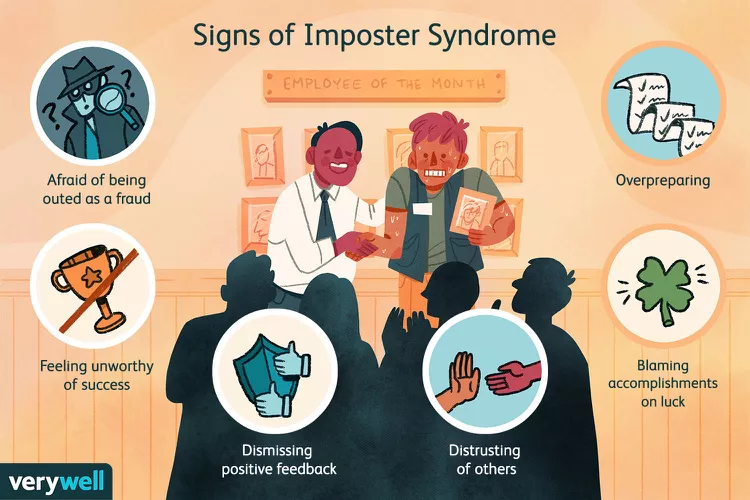
How to Beat Imposter Syndrome- Free Event on 01/18/24

Have you ever looked at your accomplishments and thought, “I am just lucky.”? Well, you are not alone. So has Rachel Gilmore, a 5th year PhD Student, and countless other people who experience “Imposter Syndrome.” When asked about it, Rachel felt, “I am lucky to know the questions that are on tests, lucky to have completed all the things I did in undergrad, lucky to have been accepted to grad school, lucky that no one has realized I’m a fraud yet.” However, she also said, “Reflecting on it, luck is certainly a factor, but I know I have put in a lot of work for my achievements. I think when we are surrounded by people doing the same thing we are – working towards a PhD, doing cutting edge research, etc. – it is so easy to compare ourselves and make ourselves feel invalidated. Definitely a habit that requires constant work and positive self talk.”

Dr. Brittany Knight, a highly accomplished scientist who is currently the Director of Operations for the United States Association for the Study of Pain and the Regional Director for the Connecticut Junior Science and Humanities Symposium, experiences Imposter Syndrome as well. She said, “I struggled with imposter syndrome when I transitioned to my postdoc. After completing my training, I still felt like I had so much to learn, and of course, we all do, but having completed my graduate training, I felt like there were many more expectations on my shoulders. I have since left and moved to a position with a national organization. One of the ways I combat imposter syndrome is to be as best prepared as possible for new tasks, knowing full well that I will make mistakes and have to learn. That is the bargain you make when you are a learner. It’s how we overcome and build new things by trying and failing. I try to recall everything I have learned, mastered, and then taught others to give myself some perspective. Now, I must combat imposter syndrome in new ways in my life and even my hobbies, but still, I try to call out that feeling for what it is and try to remember that I have value and I can accomplish what I set my eyes on because of everything I have achieved thus far. Those achievements are real. And they will continue as long as I keep trying to accomplish my goals.”

No matter what stage you are at in your career, or how many accomplishments you have, you are not immune to Imposter Syndrome and you are certainly not alone. If you are looking to overcome Imposter Syndrome, register here for our upcoming event with Tatyana Gao, a motivational speaker and author of Conscious Leadership Method.

Don’t Miss Out! Postdoc Alternatives in Academia and Summer 2024 Internship Opportunity (Systemic Bio)

Are you an early career researcher searching for roles beyond the traditional academic path? Then look no further! These exciting opportunities could be what you are looking for.

Free Panel Event: December 6th, 1PM EST
Ready to explore academic possibilities beyond the conventional postdoc?

Research Fellowships can be a great alternative academic pathway. Whether you are actively considering Research Fellowship positions, or just want to learn more, this webinar is for you. We will cover what the day to day might be like, pros and cons, and how to stand out as a candidate, with two institutions offering research fellowships, Rutger’s University and City of Hope. Come with questions as there will be plenty of time for Q&A! Sign up and start charting your course with us on December 6th, 1PM EST!
Register now!

Summer 2024 Internship Applications

Click the link for more details!

Happy Thanksgiving from Beyond the PhD

For many of us, the winter season, and the various holidays throughout, mean spending extra time with family. With this time comes the sometimes-dreaded questions: “What do you do?” or “What are you researching?” This may afford us the opportunity of discussing science-related topics with individuals who may not be so familiar with science, and rather than approaching these conversations with resistance or fear, Natalie and Rachel have some helpful tips for navigation these conversations. Check out their blog post for more!

Join us on 11/15 for “From PhD to Research Scientist”

Dr. Kirby Madden-Hennessey, a Research Scientist with Enrich Biosystems

Beyond the PhD is excited to welcome Dr. Kirby Madden-Hennessey, a Research Scientist with Enrich Biosystems, a start-up company. Kirby received a Bachelor’s in Science in Biochemistry from Eastern Connecticut State University in 2015 and earned her PhD in Biomedical Science from UConn Health in 2022. The focus of her PhD was in the area of Molecular Biology and Biochemistry (MBB) where she studied Lynch Syndrome, a hereditary form of colon cancer, in the laboratory of Dr. Chris Heinen.

During her time at UConn, Kirby was also involved with several organizations including the Graduate Student Organization (GSO), where she served as the Representative for MBB, and the Young Explorers in Science (YES), a group focused on scientific outreach to the local community. In addition to being active at UConn Health, Kirby was a volunteer with Dimensions Sciences, a nonprofit organization, from March 2020-September 2022 as a Business Development Intern. She also served as a volunteer with the Million Women Mentors CT Chapter on several events. Upon graduating from UConn, she accepted a position as a Research Scientist with Enrich Biosystems, a small startup company based out of Branford, CT. Currently, she is a lead on several projects there and takes part in some field application scientist responsibilities. In her spare time, she coaches girls basketball from the middle school-high school levels.

Kirby will be giving a virtual seminar about her career path on Wednesday, November 15th at 3:30PM ET. Registration for the event is free and is open to anybody interested. To attend the event, you must register using the link below.

Useful Resources at Beyond the PhD

Legal Advice

Dana R. Bucin is a partner and chair of Murtha Cullina’s Immigration practice. She represents businesses and individual clients on a wide range of immigration matters, including green card applications, work visas, student visas, foreign investor visas, asylum, naturalization, religious work visas, and various other employment and family-based immigration matters.

Dana is always very active on social media. Feel free to follow her on Facebook and LinkedIn.

Recording of Dana’s event on “Navigating visas, Employment, and Education in the United States” can be found here. We welcome you to reach out to Dana if you would like legal advice by booking an appointment click here.

Seminars and workshops

Our seminars and workshops are always free. Follow us on LinkedIn, X, and Instagram, and stay up-to-date on all our events. Missed one of our seminars? Don’t worry! We record many of our seminars and you can access the recordings here or on our YouTube channel.

Office Hours

This autumn, we’re rolling out our Graduate School Application Office Hours where you will receive personalized guidance on your application. Head over here to schedule your 30-minute session. And yes, our office hours are also FREE.

Job Board

Looking for a job? Head over to our job board to see open positions recommended by our team!