Cloudy with a Chance of Hermit Crabs

On a rainy evening this spring, the Boston Celtics and hermit crabs had a serendipitous encounter. Now, hear me out. I know you think that sentence sounds ridiculous, and I completely agree. However, I do have a point to all this, and I will get to it eventually, but first, let me take you on a journey that I went on a little while ago.

It all started with back-to-back overtime losses for the Celtics in March. If, like me, you are a Celtics fan, you just let out a sigh! You know the losses that I am talking about. So, it is very understandable that my mind drifted to those losses as I was sitting in bumper-to-bumper traffic on the Tappan Zee Bridge in New York State and not moving an inch. Neither Jose Gonzalez nor Kodaline, my two favorite artists, placated me, so I switched to my next option- Radiolab.

Since I felt a little crabby, I figured I would listen to the podcast episode “Crabs All the Way Down.” And like many Radiolab episodes, this one did not disappoint. Within the first 5 minutes, I had multiple TIL moments (aka. Today I Learned). I will give you one right now. Did you know that (nearly) all hermit crabs you have encountered on boardwalks were captured from the wild because it is apparently impossible to figure out how to mass-breed them in captivity? Yeah, neither did I. As you can tell, this episode had me hooked. Not even this guy, Dr. Chris Tudge, who had spent years studying the reproductive biology of these somewhat adorable creatures, had an answer. Answers remained elusive until artist Mary Akers came along. And this is where our journey begins.

After her last kid moved out of the house, Mary, like many parents, experienced “empty nest syndrome.” Spoiler alert- a pet hermit crab filled the void in Mary’s life. It was offloaded onto her by a friend, and as the new owner of the tiny creature, Mary’s first plan of action was to figure out how to care for hermit crabs. She was heartbroken when she found out where all the hermit crabs came from but was fascinated to learn that they could live for decades if you sprinkled them with love and care. And so, she decided to buy more hermit crabs and form a “crabitat” in her daughter’s bedroom.

Mary named the crabs, brought them shells, fed them, observed them every day, and spent a significant amount of time with them, so much so that she noticed one of them walking funnily one day, only to discover that her hermit crab was carrying eggs. She built multiple pools for the pregnant crab to choose where to lay her eggs, and once the eggs hatched, she used a turkey baster to replace the dirty water, and at this point, you would think, YAY! Right? Hermit crab lays eggs, eggs hatch, hermit crab babies grow up, ergo, more hermit crabs. Wrong!

Unfortunately, after a while, all the newly hatched hermit crabs died, and no matter what Mary did, they did not survive. Mary was understandably devastated but was determined to care for those tiny crabs, so the following summer, when one of her crabs was carrying eggs, she decided to build a different kind of tank, grew another type of seaweed, and also built a ramp to mimic a hermit crab’s journey from the ocean to the land. And then Mary did the unthinkable, “she decided to not only stop caring as much but to also become the ocean.” I pulled that phrase from the podcast because there is no other way to describe what she did, and it was powerful how she phrased it during the episode. Mary stopped treating the tiny crabs like delicate creatures and instead chose to simulate what they would experience in their natural habitat. She became the ocean.

She agitated the tank, mimicked those rough tides, and slowly, one day, she saw a tiny hermit crab cross that line from the ocean onto the land. Mary had succeeded- she added over 200 hermit crabs to the world that summer. She succeeded when scientists who studied this creature for a living failed. Dr. Tudge, a leading expert in all things hermit crabs, was naturally awestruck by what Mary had achieved. And it all comes back to that phrase- she became the ocean. It was more than just rocking the tank back and forth. The water had to be changed, and oxygen levels had to be maintained, etc. But Mary figured that out. Armed with nothing but a turkey baster and absurd levels of determination, this artist, and a loving mom of three, achieved the impossible. She had successfully mass-bred hundreds of hermit crabs.

One look at Mary’s blog will tell you the hours spent observing, recording, detailing, figuring out alternatives, and, most of all, the care involved in this process. If you work in a lab, it will remind you of your countless failed experiments and detailed lab notebooks, the seemingly unimportant things written down with the hope of finding that “AHA!” moment, the feeling of despair when nothing is going your way, and the urge to give up. Most of all, it will remind you that sometimes, when things seem dire, it is okay not to care. The point of all this was not to convince you to mass-breed hermit crabs but to remind you that while science is fraught with failures, science is for everyone. There is a scientist inside all of us, and you do not need a PhD to be a scientist. Be meticulous and persevere like Mary, and you will succeed. But most of all, be curious!

I will now sign off with this AI-generated image of a hermit crab wearing a Boston Celtics jersey (or at least what my friend’s bot thinks it would look like).

Preparing for a Career at a Teaching-Focused Primarily Undergraduate Institution (PUI)


If as a grad student, you are anything like I was, then you likely know you are already interested in becoming a professor at a primarily undergraduate institution (PUI). This article is for you. If you haven’t even heard of a PUI before, don’t worry, this article can still be for you!

Having gone to a small, public, liberal arts college myself, the mentorship I received during my undergraduate career was paramount to where I am today. I knew that once I finished my doctoral training, I wanted to give back to students by providing the same level of support that I had received. As a first-generation college student, nobody in my family knew what careers in science were all about, nor did I, nor was I even interested in first about careers in science. I can go on for days about my own journey, but I thought I should stay focused (for once) and talk about my own personal advice and some advice I was given about pursuing a career at a PUI (primarily undergraduate institution).

What is a PUI? Primarily undergraduate institutions are often smaller colleges or universities that differ greatly from larger research universities – the type of school you may be pursuing your graduate education at. PUI schools can be either private or public, offer different types of resources both for faculty and students and have varying levels of research present at the college or university. As a professor at a PUI, your role is often multi-faceted. You are faced with a heavy teaching load, typically a 4-4 or a 3-3 if you are lucky. Those numbers correspond to the number of classes you teach each semester. If you teach at a 4-4 college, this means you teach 4 classes (typically 12 credits) in the fall and 4 classes (typically 12 credits) in the spring.

At my current institution, I am responsible for a 4-4 teaching load. Also depending on the size of the college, these classes may all be the same, or may all be completely different, as in my case. Something that many people are unaware of is that at these smaller colleges, you likely will be teaching subjects outside of your comfort zone, something that takes some time to get used to. Depending on the size of the school, you may have to be a “jack of all trades”. For instance, at my college, I teach half biology and half mathematics due to my occupational background prior to graduate studies. My experience is not unique though. My friends and colleagues at other institutions have backgrounds in cell biology or neuroscience, but end up teaching classes like microbiology, anatomy, physiology, or nutrition, even though they did not specifically study in those areas. You may be thinking to yourself, “How can I teach a class in an area that I don’t have a specialty in?” The answer is—you have a Ph.D.! Therefore, you are one of the fastest learners out there. You spent the last x-number of years of your life learning material quickly and efficiently to prepare yourself for any number of questions from your committee. In reality, that is not much different than you preparing a lesson plan to teach a class on muscle physiology, even if you are a geneticist.

How do you get a tenure-track position at a PUI? When applying for graduate schools, I focused heavily on schools with teaching assistantships. However, I ended up getting accepted to schools without teaching assistantships and pursued my Ph.D. in a research-intensive program. My biggest piece of advice: get as many opportunities to mentor students as possible! Most programs also allow you to get experience as an adjunct professor or teaching assistant at other local colleges. Finding the first job is ALWAYS the hardest. Nobody wants to take the risk of hiring a Ph.D. student without any formal teaching experience. Once you get that first one though, the others come far easier. I was extremely fortunate in that I was an adjunct for only 3 semesters before I landed my full-time tenure track position. Others aren’t as lucky, but never give up!

What is it like working at a PUI? Again, everybody has a different experience, and this is especially dependent on the school that you work at. I personally find my career beyond rewarding. I love teaching others about things I know and inspiring interest in things students never thought about before. Those ‘aha’ moments are the reasons I stay in this profession. Beyond your heavy teaching responsibilities, I mentioned earlier, you are also required to participate in department and general faculty meetings and participate in service to the college. This typically looks like serving on college committees, which vary in time commitment and participation requirements. You also have advising responsibilities on top of that. Oh, and if you think that’s enough, you also have your scholarly activity. Scholarly activity is defined as contributions to research in your field or research on teaching pedagogy. This is can be one of the hardest components to accomplish, depending on your institution. Some institutions have fantastic laboratory spaces, others do not. A common thread is that most department budgets do not pay for research. Also, most small institutions do not have animal facilities or fancy equipment that you’ve become accustomed to in your R1 institution’s laboratory spaces. When preparing for a career at a PUI, do a mini “literature review!” What things have been done at the college previously? How expensive is your research to get off the ground and running? A key to success in your research agenda is to link it to classroom learning. This will not only make it easier to get funding through your college, but students will be able to apply what they are learning in class to a hands-on project. Your responsibility is to give undergraduate students real, hands-on experience. A huge piece of advice that I was given when thinking about the research agenda was to keep it simple. Think: what skills will students gain from participating in research with you?

Even though every occupation comes with its own challenges, I personally find that the benefits far outweigh the drawbacks. If I were given the chance to start over, I still wouldn’t trade my position.

Did you find this article helpful? Are you interested in teaching at a PUI? Connect with me on Linkedin. I’d love to hear from you! And don’t forget to follow Beyond the Ph.D. on our socials at beyond-the-phd.com for more career guidance and other STEM-related content!

The Importance of Making and Maintaining Connections

While you may or may not always be on the job market, it is not only important to make connections, but to maintain connections with your network that you have made. Your network as a whole should be different from a “friend group”. Your network should have people that you have worked with, people that you have met through professional means (networking, conferences, etc), and individuals that you want to be like. What makes a good network? I believe that the best quality of your network is not quantity, but quality. It is tempting to connect with every individual in your company on LinkedIn and most times those individuals will connect with you, but what good does this do for you? If somebody asked one of these random connections what your best qualities are, they will likely respond with “not a clue”.

So, who should you network with and why? Off the bat, you should connect/network with your current team/department and past teams/department. You have worked close with this group of individuals and staying connected with these individuals (whether personally or through an online networking tool such as LinkedIn) will allow you to stay up to date with your past lab mates or team members career developments . If you worked in a similar department, staying connected can help you see various career trajectories of your colleagues without doing much research on your part.

If you are completely new to your field or you are entering the job force after completing educational training, who should you connect with? The best way to make these connections is reaching out to individuals on LinkedIn who have careers that you are interested in. If you want to learn more with who you should/how you should reach out, check out our article on “Using LinkedIn to create your brand and network”.

If you put the time in to making connections through LinkedIn you will find yourself with an arsenal of connections on LinkedIn. Like any social media website, it is important to stay engaged on the professional networking platform. This doesn’t necessarily mean posting content every day. It is important to not “spam” your network. Instead, consider creating and posting content as well as liking and celebrating posts made your network members. This can lead to a potential gateway to conversations. Another way to stay engaged with your network is to schedule in person or virtual one on one check-ins with members that you would like to create deeper connections with such as professional mentorship relationships. If your connections are local, grab a coffee or a beer. If they are more distant, schedule a quick zoom meeting and have a virtual coffee or lunch meeting.

Having face-to-face contact, whether in person or online, builds a stronger relationship with your connections. If you are anything like me, it may be hard to continue to reach out to individuals online. Tools like Refer.com can allow you to track your contacts and remind you to reach out to specific individuals based on time periods you set. Depending on the type of contact, this should determine how often you should try to engage with them. Also remember to be respectful of your contacts schedules.

An article posted in the Wall Street Journal titled “Take your search for a job offline” states that 80% of job openings are never publicly advertised. Many times your connections on LinkedIn will know of employment opportunities so staying connected could enable you to be a VIP in learning about a position before the opportunity goes out to the public. Following up with connections over the years, pruning current contacts, and maintaining vibrant relationships can give you an edge when looking for employment opportunities. However, don’t treat your network solely as “what they can do for you” and a one-way relationship, but try to think of value you can provide to your connections. In a recent article published in Harvard Business Review, the authors dive into the importance of maintaining professional relationships including listening to your members and what they need. This could be as simple as sharing a connection’s post if they are looking for something, or even providing your own expertise in a subject matter. Provide this service to your network without requiring something from your network.

What’s the take-away message from this article? Make meaningful and helpful connections via social media, and engage with these contacts over the years. Share your successes, your insights, and thoughts. Take time to help others and don’t be afraid to ask for help yourself. Now, go back to your social media platform and take some of this advice. Happy Networking!

🌍 Oh, the places you’ll go! ✈️

Outside of science, one of my passions is to travel and experience new places, cultures, and food. While it may not seem that a career in the sciences or signing yourself up for more school by pursuing a PhD would allow the time or means to explore this interest, I have found that my scientific career has led to many opportunities to travel that I may not have had otherwise. So let me tell you about a few of the ways I have been able to travel within my PhD.

One of the most obvious ways to travel throughout your PhD is to attend conferences or workshops that allow you to enhance your professional development and scientific knowledge, but also give you the opportunity to explore new places. Attending scientific conferences and workshops in different cities or countries can be a catalyst for networking and collaboration. These events bring together researchers, scientists, and scholars from around the globe, creating an environment conducive to knowledge exchange and fostering professional connections. Conference travel has taken me from places like Washington, D.C all the way to Lausanne, Switzerland. One of my favorite conferences took me to Parma, Italy! This conference was very specialized for my field of study and allowed many chances to network with companies pursuing similar lines of work, present my research during the week, and receive some of the best feedback on my project. Outside of the conference, I could explore the city, take in the wonderful sites, and fill up on pasta topped with Parmesan cheese from the source! This was the perfect blend of professional development and personal interest. While not every conference takes place in remote, idyllic places, there are plenty of amazing conference opportunities that can also align with your travel interests.

Another way I was able to travel during my PhD was through a collaboration with two labs in Rome, Italy. Through this project, I traveled to and worked in Rome for three months, learning new skills and working on a really cool project. This opportunity was packed with new experiences. Outside of the progress I made on the project, the best takeaways from this opportunity were experiencing a new mentorship style from the PIs there (and further understanding what I would look for in future employers!), making friends in a different country despite language barriers, and fully immersing myself in a new lab culture. The sights I saw and the excursions I went on were unbelievable and without this collaboration, may not have been possible.

While these are the experiences I had during my PhD, there are many other ways for you to get out and see the world. Two other examples that I want to highlight are looking at international PhD programs and post-doctoral positions in cities that you want to experience long-term. I have seen many peers thrive in these types of environments and it may be the best way for you to combine your passions for science and travel.

One big question in all of this is, “How do I pay for it?” My experiences were funded through my research grant, since most grants allot funds for travel related to the research project. Additionally, many PhD programs and research institutions offer funding opportunities for students to present their research at conferences or conduct fieldwork abroad. Take advantage of these resources by exploring grants, scholarships, or fellowships specifically tailored for travel-related expenses. Keep an eye out for departmental or institutional travel grants that can support your scientific and personal exploration.

Sometimes a science career can become overwhelming or monotonous, but having the opportunity to travel within your career, often on someone else’s dime, can re-spark your passion for science, like it did for me. It’s crucial to strike a balance between academic commitments and personal growth. Visiting new places, immersing yourself in different cultures, and experiencing diverse perspectives can broaden your horizons and enhance your understanding of the world. Exploring scientific conferences, research facilities, and collaborating with experts from different regions can provide fresh insights and open doors to new research avenues. So, get out there and enhance your scientific knowledge while seeing the world!

Join Us as a Fall 2023 Campus Ambassador for Beyond the PhD! Apply by September 15

Are you an enthusiastic and driven student looking for an exciting internship opportunity? Look no further! Beyond the PhD is seeking talented undergraduate, graduate, and postdoctoral fellows to join our Campus Ambassador program for the upcoming semester.

As a Campus Ambassador, you’ll have the unique chance to represent Beyond the PhD and make a meaningful impact on your campus community. Here’s what the program has to offer:

🌟 Disseminate Event Information: You’ll be at the forefront of spreading the word about our engaging Career Discovery Seminars, career development workshops, and more. Your responsibility will include distributing fliers and other promotional content through captivating social media posts. Create your own or share some of ours! Get ready to showcase your marketing prowess and connect with peers who are eager to explore career options. Follow us on LinkedIn, Twitter, Facebook, and Instagram!.

🌟 Organize a Seminar: Take charge of organizing one seminar during the following semester following your internship. From selecting compelling speakers to coordinating logistics, you’ll have the opportunity to shape an event that empowers students to unlock their post-PhD potential. This hands-on experience will develop your event planning and leadership skills. You might get to meet some professionals in the field that just may just help you on your journey!

🌟 Grow Your Professional Network: Join a dynamic team of fellow Campus Ambassadors and the larger Beyond the PhD Team who are all dedicated to fostering your professional growth. Collaborate, brainstorm, and strategize with peers on innovative ways to enhance our outreach efforts. Along the way, you’ll build valuable connections, expand your network, and gain insights into the professional workplace.

If you’re excited about championing the Beyond the PhD mission, expanding your skill set, and making a difference in the lives of students, we want to hear from you!

🔎 Eligibility Criteria:

Current undergraduate, graduate, or postdoctoral fellow at a university or college

Passionate about supporting PhD students in their career exploration journey

Excellent communication and organizational skills

Active presence on social media platforms

📆 Program Duration: Fall 2023 Semester (starting in August, 2023).

Ready to embark on this incredible opportunity? Apply now to become a Fall 2023 Campus Ambassador for Beyond the PhD! Show us why you’re the perfect fit by submitting an application using the link below. resume, a brief cover letter highlighting your interest, and any relevant social media handles.

📧 To Apply: https://forms.gle/6pB6cxPGeZDxpmep6

Join us in shaping the future of career exploration for PhD students and create lasting impact on your campus community. We can’t wait to have you on board as a Beyond the PhD Campus Ambassador!

Note: Deadline to apply is September 15

Cracking the Dissertation Code: Insider Tips for Writing Success

The summer months can be a great time to write. You may need the summer to catch up on some papers or perhaps you are nearing the end of your training and you need to begin the process of writing your dissertation. How do you start and finish your dissertation over the summer? Below are a couple of tricks to help make the process manageable.

Writing can be a significant task for many people. Even more so, writing your dissertation can feel overwhelming and daunting. How does it take? Where do you start? How does your dissertation even get written while you are completing experiments in the lab?! Writing your dissertation requires careful planning, organization, and discipline. Most importantly, it’s essential that you come up with a consistent writing program that works for you so that you continually make progress.

The best writing happens over time and not in the 12th hour although you might think it does. Your dissertation is a bear of a task and you simply cannot wait to start until the night before it’s due to your committee. Below are some tips to help you on your dissertation writing journey:

Start early and set realistic goals:

Begin writing as early as possible to allow ample time for research, analysis, and revisions. Break down your work into manageable tasks and set specific goals for each stage of the writing process. It may take some time to organize your thoughts so keep a rough sketch of topics in a secure location and revisit again when you are ready to begin outlining. Depending on your program, you may have a limited amount of time to write your dissertation so setting goals that do not hinder your overall motivation to write is extremely important.

Develop a clear outline:

An outline will serve as your roadmap during the writing process. Create a detailed outline that provides a logical structure for your dissertation. How many chapters will you have in your dissertation? Will your introduction be one or several chapters? Outline each of the main chapters and then start outlining the sections and subsections within each chapter. During the outline process, include key points and arguments you want to address in each of the sections and in the chapter overall. Address these main arguments within your final chapter. In a word processor you can use bullet points or headings to create your outline, or you may consider utilizing a mind map to organize your thoughts and key elements of your dissertation. Your outline should be as specific as possible. Run this outline by your mentor or other trusted individual to get feedback BEFORE you start writing.

Conduct thorough research:

Gather relevant literature, primary sources, and data to support your research objectives. Take detailed notes and properly cite all your sources. This will help you build a strong theoretical framework and provide evidence for your arguments. Use a citation manager to organize and format your citations.

Establish a writing routine:

Set aside dedicated time for writing and establish a routine that works for you. Use your outline to help guide your writing and to prevent writers block. Find a quiet and comfortable space to minimize distractions. Consider using productivity tools or techniques, such as the Pomodoro Technique, to enhance focus and productivity. One of the tricks I learned was to use a timer to set aside blocks that were uninterrupted for 30 minutes or longer to sit down and write. To do this you must close out your email, put your devices on do not disturb or another quiet mode, and write without distraction. Another tip, to avoid accessing the internet during this distraction-free writing time, have a scratch piece of paper near your work area to jot down ideas for papers or information to look up after the session has ended. 

Write regularly and revise:

Aim to write consistently, even if it’s just a small portion each day. Especially if you have a tight turnaround. Set aside time during the quietest time of your day. If you get a lot of emails or distractions in the middle of the day, consider writing at the beginning of your workday or at the very end. If it is possible, choose a different work area to write rather than your normal workstation such as the library or a study room. Focus on drafting individual sections or chapters rather than aiming for perfection in the first draft. Write first and THEN edit. Once you have a draft, revise, and edit it thoroughly for clarity, coherence, and grammar. Move around subsections of your chapters depending on the flow of your writing. As your dissertation starts to take shape consider the narrative and the arguments highlighted in the text, does your introduction adequately set up these arguments?  Consider the history of the field you are studying, what information is important for understanding how you got to your question? Don’t forget to include a couple of figures and/or images that can aid your readers as well as break up long text (in addition to using subheadings).

Seek feedback and support:

Share your work with your advisor, committee members, or peers for feedback and constructive criticism. Incorporate their suggestions to strengthen your arguments and improve the overall quality of your dissertation. You do NOT need to take everyone’s advice; this is your document after all. Consider joining writing groups or seeking support from writing centers or workshops. This can help you stay accountable with your writing program or provide some social support as you spend long hours writing.

Take care of yourself:

Writing a dissertation can be mentally and emotionally demanding. Take regular breaks, practice self-care, and maintain a healthy work-life balance. Seek support from friends, family, or support networks to stay motivated and focused. Take time to go for walks, dance it out, or hang with your friends and family. The time away from your writing will help you. So it is important to make space for other things while you write. Drink water and balance the junk food with some good brain food.

Stay organized and save ALL of your drafts:

Keep track of your research materials, notes, and drafts in an organized manner. Use reference management tools like Zotero or EndNote to manage your citations. Regularly backup your work to avoid any potential loss of data. Keep ALL drafts of your documents. DO NOT DELETE large parts of your writing if you do not like it. Just cut and paste into a new document and save for later. YOU NEVER KNOW when you might want a sentence from that excerpt, or you like something else about it. Just keep that text in another document for later.

Remember that writing a dissertation is a marathon, not a sprint. Celebrate your progress along the way and stay committed to the process. Use your support system to ground yourself during the process. You will finish. You just have to start!

UConn Alumni share their experiences transitioning to industry

The panel on April 26th featured four alumni of the UConn Health Biomedical Sciences PhD program at UConn Health Center in Farmington, Connecticut. The panelists shared their experiences transitioning from their academic training to various positions in industry. The panelists included Dea Gorka, PhD, who graduated in 2022 and now works as a Research Scientist at Arvinas Inc. in New Haven, Connecticut. Spencer Keilich, PhD, who graduated in 2020, currently is a Scientist III position at Millipore Sigma in Waltham, MA. James Fink, PhD graduated in 2018 and joined a startup called Q-State Biosciences, where he now serves as Director, Epilepsy Therapeutic Lead. Finally, Matt Antel, PhD, who recently graduated from UConn now works as a Sales Representative at STEMCELL Technologies, where he works with local groups in both academia and biotech to support their immunology workflows.

General Advice

“I would say that it’s going to be fine no matter what you choose. I think it’s really scary whether you’re going to postdoc and the worries that come with the uncertainty of academia and getting jobs or having successful postdoc or going to industry and is it going to be the same science I want to do? … You’ll find that you will gravitate towards the things that interest you. Being part of your training is being open minded to new scientific questions. If the right people are around you, mentoring you and cheering you on, then I think you’re going to be just fine.”

Thoughts on the Job Search

The panelists discussed their journeys and the timing of their job searches. They emphasized the importance of starting early and being open to different opportunities.

“If you don’t think you’re qualified, you probably are just because you have the potential for it after going through a PhD program.”

Some knew from the beginning of their PhD program that they wanted to work in industry, while others discovered later that academic research was not their preferred choice of career.

“…There are also options intermediate between graduating and continuing on. I understand most people probably wouldn’t want to do that, but if you do have the option to stay on as, like, a postdoc and your advisor is okay with that, it could help you feel less stressed about having to find a position immediately after you graduate.”

Was your LinkedIn profile useful in getting you your job?

“So, I would say that maybe it’s not so much daily posting on LinkedIn so much as having your updated documents ready to go on LinkedIn and being able to apply through the LinkedIn job search tool, because you can filter for anything you want to filter for and it’s a really great tool.”

“And also in 2023, personal branding matters a lot and LinkedIn is your professional brand, right? Everything you have on your LinkedIn page is sort of reflective of who you are, sort of your skills you have, how you present yourself, what you want the external world to see about your professional profile. And so, I think that in that way, it’s also important.”

“I also found the job for our business through LinkedIn and then a couple of the other positions that I ended up getting but rejecting for Venice. It was just through a random recruiter on LinkedIn. So, look through your messages, it’s usually not spam. And, I paid for the premium for one month and I found that actually to be really helpful for LinkedIn because it does show you exactly what the hiring manager is looking for. Skill sets, for example. So maybe there’s something that you didn’t think was important to put for LinkedIn specifically or on your resume.”

Thoughts on Converting your Academic CV to a Resume for Industry Positions.

It was suggested to tailor the resume to match the specific requirements and to include keywords specifically mentioned in the job posting. Priority should be given to highlighting your relevant skills and experiences on your resume and not necessarily your academic publications.

Thoughts on Industry Interviews.

The panelists shared insights about their interview processes, which typically involved multiple rounds of interviews with different individuals, including hiring managers, supervisors, team members, and sometimes even higher-level executives.

“You need to know your worth as a scientist, as a critical thinker, or whatever role you’re applying for. And I think the people you’re interviewing can sense that. And especially when and if you do get that job offer, advocate for what you think you’re deserved in that role. Do your background research, like look at Glassdoor, stuff like that and figure out what you want and what that company can provide and how that can mesh together.”

“Treat an interview not just as a one-way street. It’s more than just you trying to get a job. It’s also you trying to find what fits for you. So, if you know going in that you won’t be happy because of the type of work or personality that you find during the interview process, then maybe consider that that’s not for you.”

“Don’t be afraid to just turn it down if it just seems like a bad fit. Because you don’t just have to take something. It’s long process. [Job searching] It’s not easy or anything, but there are opportunities out there. So don’t get stuck with the first one that you think you should take just because it’s easy, if that makes sense.”

Thoughts on Interview Presentations/ Job Talks

The duration of the job talks varied among the panelists, but it was emphasized that these talks are to showcase your range of skills and experiences rather than solely focusing on your dissertation research. Your presentation should be clear and timely. You should present yourself as a team player and don’t forget to showcase your research collaborations. Finally, your talk should address the significance of your research as well as convey its potential marketability. While publications were seen as important by some employers, the panelists often conveyed that they did not feel their publication record was the defining factor that led to their job offer. As far as timing to receiving a job offer, panelists shared that often it took several weeks to a couple of months from the initial application to receive an offer.

The panelists mentioned three main challenges they overcame at the start of their new position.

Communicating to Broad Audiences: They highlighted the need to communicate scientific concepts effectively to individuals who may not have a scientific background. In industry, it is crucial to be able to explain the significance and implications of research in a way that can be understood by colleagues from diverse backgrounds, such as sales, marketing, or engineering.

Having a BIG Picture Mindset: Panelists shared that they often have to shift their mindset from focusing solely on specific research projects to considering broader goals, such as product development and patient outcomes. This shift in mindset involved aligning experiments and research goals with the overall objectives of the company.

Learning Business Skills: While some panelists mentioned that having business skills or an MBA could have been beneficial, they also highlighted that it is possible to learn and acquire those skills while working in industry. The importance of continuous learning and adaptability was emphasized, as the transition to industry often requires developing new skills and adjusting to different work environments.

The speakers also shared their perspectives and advice for anyone transitioning to a position in industry or a postdoctoral position.

(1) The importance of being open-minded, gravitating towards your personal interests, and having a couple of supportive mentors to guide you through the process. Tips for finding a mentor: https://www.npr.org/2019/10/25/773158390/how-to-find-a-mentor-and-make-it-work

(2) The interview process is a two-way street, you must also assess your “fit” in the company. Don’t just take a job! Resource on assessing your fit: https://harver.com/blog/organizational-fit/

(3) Confidently advocate for yourself and research the company’s offerings before the interview. Remember to negotiate! More about negotiation skills can be found here: https://online.hbs.edu/blog/post/negotiation-skills & https://ctaiog.home.blog/2023/05/17/negotiating-salaries-and-job-offers/

(4) The timing of securing a job varies, with some applying months in advance and starting immediately after graduation, while others took a postdoc position for a transitional period.

(5) Try to take some time after completing your degree to recharge.

Overall, the panel provided valuable insights into the transition from academia to industry and the different paths that can be taken after completing a PhD in biomedical science.

Negotiating Salaries and Job Offers

Navigating negotiations can be a daunting task. When job hunting or accepting a job offer, there are many things to consider. Salaries, benefits, and other aspects such as remote work can all be part of a job offer package. Some people might be tempted to just accept the terms given, but you can negotiate many aspects of a job offer other than just salary. Recently, I took a useful and informative MBA class called Negotiation Strategies. In this course I learned some helpful tips and tricks about negotiations and ways you can get the most out of a job offer that I have compiled to share with you in this article.

Surprisingly, many people do NOT negotiate their salary or job offer. This could be for a variety of reasons. First, many people don’t know it’s an option! Additionally, some individuals don’t know what they are worth and are hesitant to advocate for more. To combat this, do some homework! Use tools like Glassdoor or LinkedIn to look at comparable positions and compensations. Completing this step will help you feel more confident when negotiating. There are also individuals who are uncomfortable negotiating with a potential employer and are afraid of appearing greedy. However, you won’t appear greedy, especially if you can explain “why” you deserve more and back it up with the market research. In fact, most companies will leave room in the initial offer and expect you to negotiate. Finally, some people are afraid that a company may rescind an offer if they negotiate. However, it is rare that a company will rescind an offer simply because you tried to negotiate for a better package. This only happens when candidates are too demanding, rude, or not considerate of the employer. No matter what the reason, it’s okay and often expected that you will try to negotiate.

There are many things you can do to prepare for a salary negotiation. People tend to find job negotiations difficult, especially because people tend to closely associate salary with their self-worth. As mentioned earlier, doing your homework is important. Knowing your worth and conducting market research can make you feel more secure in your dealings with a new company. Also, many companies expect you to negotiate, so they often do not start with their best offer. Realize that there is most likely some wiggle room in any offer.

Be aware that salary is not the only aspect that you can negotiate. Many offers will include a vague description of the company’s benefits. First, ask for a detailed description of the benefits. Comparing differences in 401k plans, health plans, vacation time, retirement benefits, relocation expenses, and other items can make a big difference when comparing offers from different companies. Finally, if all else fails and the employer won’t budge on salary or other benefits, realize that you could ask for an expediated review after starting at the company. Make sure to get this in writing, but having an expediated review can help you get promoted faster. Overall, you should consider the entire package, and negotiate accordingly.

When job hunting, it is often good to try and solicit multiple job offers. This can help you to compare between offers and allows you to use them as leverage in negotiations. Even if you don’t have multiple offers, knowing the minimum compensation that you will accept as well as a desired salary range is important. Importantly, don’t be afraid to set your reservation point, or walk away point. Always make this decision prior to the negotiation so that you are less influenced by emotions in the moment. It is also important to keep in mind that you don’t need to accept the first offer that is given to you. Additionally, you can ask for more time to decide if you are unsure or are comparing between multiple offers.

People may be hesitant to negotiate out of fear of appearing greedy or ungrateful. However, it is okay to still try and negotiate for better terms. You might be wondering how to ask for more without appearing greedy. Luckily, there are steps you can take to put your best foot forward. After completing your market research, you should show your potential employer a list of compensation benefits for comparable jobs in similar companies. Additionally, always express enthusiasm for the job and express hesitancy for the parts of the offer that fall short or that are offered by other companies. Importantly, be sure to avoid personal needs and focus on the value that you will bring to the company. Some reasons that may not be good to bring up are things such as education loans, housing costs, or other debts. Instead, clearly articulate the value that you will bring and the unique skills and abilities that you offer.

A difficult situation that many job hunters find themselves in is when a company asks for salary expectations before an official offer is on the table. This could happen during an interview or early on in conversations about the role. Employers may ask this question to determine whether your expectations are in line with what they are able to pay. Alternatively, they may hope that you will undervalue yourself so that they can save money. When facing this situation, be cautious. Don’t overstate your salary requirements as it may be a reason that a potential employer may stop considering you for a position. If an employer insists that you provide salary expectations, there are a few ways to handle the situation. First, you could delay. Saying something such as “I would like to learn more about the position and how I can contribute to your team before discussing salary” can buy you more time and get you more information about the role. You could also ask for clarification and see if the company could provide a range for the role. Alternatively, you could give an industry average that is in line with your expectations. If the employer is insistent on a number, provide a realistic range based on your market research and desired compensation.

At any stage of your career, you can negotiate. Negotiating your salary is extremely important, and your starting salary can act kind of like an anchor. Things such as future raises, bonuses, and even retirement savings can all be influence by this initial amount. It is also important to note that there are gender differences in negotiations. Men initiate negotiations about four times as often as women. In fact, 20% of adult women say they never negotiate, even when it may be important. No matter the situation, negotiating from the start can help boost your career and get you the best offer available. There is a cost to not negotiating. Small initial differences in compensation can lead to big results later on. When you don’t negotiate, you risk losing out on large amounts of money over time.

Overall, knowing your worth and not being afraid to negotiate for yourself can lead to long term benefits. Don’t be afraid to advocate for yourself and help your career along the way.

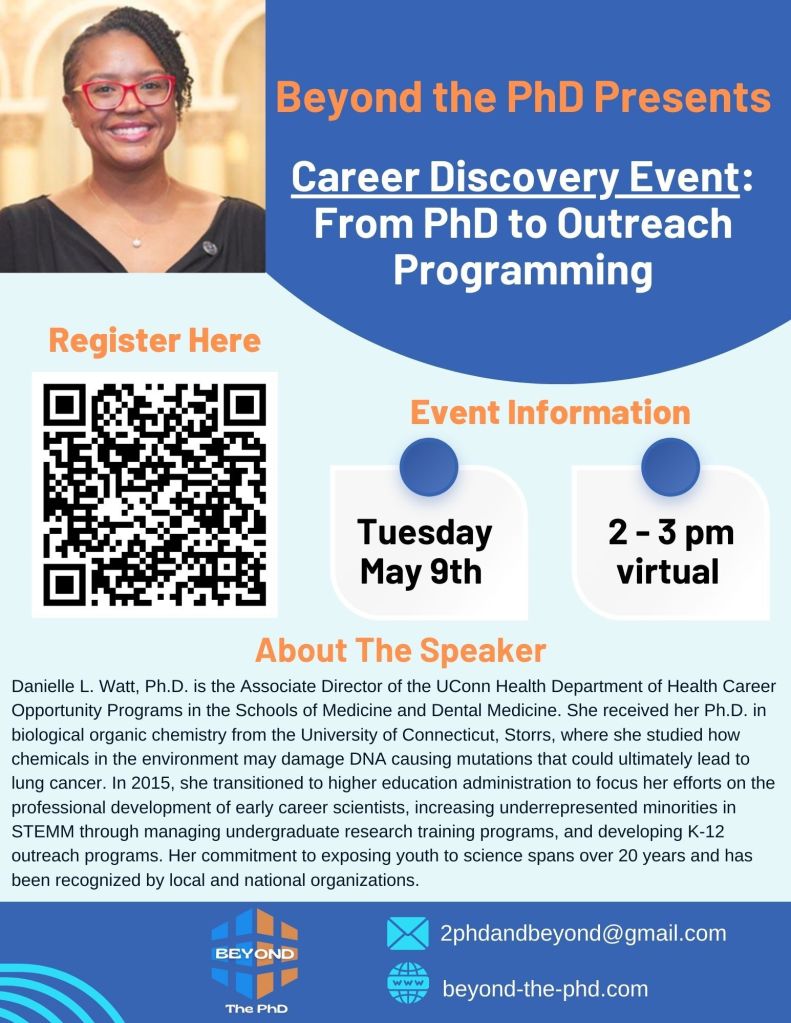
Upcoming Event on May 9th: From PhD to Outreach Programming

On May 9th Beyond the PhD will feature Dr. Danielle Watt. Danielle L. Watt, Ph.D. is the Associate Director of the UConn Health Department of Health Career Opportunity Programs in the Schools of Medicine and Dental Medicine. She received her Ph.D. in biological organic chemistry from the University of Connecticut, Storrs, where she studied how chemicals in the environment may damage DNA causing mutations that could ultimately lead to lung cancer. After completing a postdoc in DNA replication and repair at the NIEHS, NIH, she spent two years conducting DNA replication research at Umeå University, Sweden. In 2015, she transitioned to higher education administration to focus her efforts on the professional development of early career scientists, increasing underrepresented minorities in STEMM through managing undergraduate research training programs, and developing K-12 outreach programs. Her commitment to exposing youth to science spans over 20 years and has been recognized by local and national organizations, including the NOBCChE Dr. Henry McBay Outstanding Educator Award and the NIH Merit Award.

Register here (Free!): https://www.eventbrite.com/e/from-phd-to-outreach-programming-tickets-627094395217

From PhD to Science Reporter

Have you ever felt like you love reading, writing, and talking about science more than actually doing science? Then science reporting might just be the right career for you, according to Dr. Angie Voyles Askham, a science reporter for Spectrum. Our paths crossed at a neuroscience conference when she wrote an article for Spectrum on my lab’s research. In a recent seminar for Beyond the PhD, Angie talked about her journey, and what made her transition from working at the bench to reporting about it.

Like many of us in undergrad, Angie was undecided on a major, and after much deliberation, her love for biology led her to choose neuroscience. Since she loved science and the research she did as an undergrad, graduate school was an obvious next step. Alas, at the thick of her PhD research at NYU, Angie realized that as much as she loved learning about science and all the cool, new techniques and developments that come with it, she did not enjoy doing them as much. Her circuitous path, as she liked to call it, eventually led her to her current job as a science reporter, a job she loves. However, Angie wishes she had realized what her true passion was much earlier, and without as many detours. Some advice she gave right off that the bat was to ask yourself, “What do I like to spend my time doing?” For Angie, that was writing- a thing she enjoys, and has always enjoyed doing.

While contemplating her next career move as a PhD student, Angie decided to take a science communication workshop through the journalism school at NYU. Not only was she reminded at this time how much she loved and missed writing, but the workshop also helped her understand how to write effectively without using science jargon. Pro tip #1 from Angie: If you are considering a career in science communication, workshops are a great environment to improve your communication skills, as well as get valuable feedback for your work.  

While it can be daunting to make a career change, Angie’s advice was to break down the skillsets you would like to acquire and look for jobs or internships that would help you build those skill sets. Prior to joining Spectrum as a science reporter, Angie dabbled in many different aspects of communication- an internship at WYNC, radio journalism in Seattle, academic publishing, and even freelancing. She spoke at length about how internships were a confidence booster, and that even freelancing, while it did not pay much, was valuable experience. Her advice was to think about the kind of communication or writing you would like to do- radio journalism vs editing vs academic publishing vs reporting etc. Pro tip #2 from Angie- check for internships at your local radio stations. They can help you understand how to pitch your story and think outside the box. However, many of these internships might require you to be a student or a recent graduate, so plan ahead.

So, what exactly does science reporting entail? Angie broke it down into 2 parts- finding a story and writing the story. Both parts of the job involve attending conferences, talking to researchers, reading papers, looking through Twitter, reading more papers, fact checking, and a lot of editing. And, of course, writing. Yes, it sounds a lot like graduate school- just minus the actual lab work. She also mentioned that despite being an introvert, she enjoys talking to people and learning about exciting new research from them. You can refer to Angie’s unofficial checklist to know if science communication is the right career for you.

  1. You like attending classes.
  2. You like to write and talk about science more than you like doing science.
  3. You like diving into past research.
  4. You like learning a new topic every week.
  5. You are kind of a nosy person (in a nice way).

While Angie’s path to science reporting was a little unconventional, her valuable advice could make your path more straightforward.

  1. Apply to the AAAS Mass Media fellowship– a competitive, 10 week long summer program for an opportunity to work at NPR, Wired, NOVA among other media organizations.
  2. Enroll in science communication workshops, especially if your university has a journalism school.
  3. Apply to internships at Spectrum, STAT, etc.
  4. The most straightforward way would be through journalism school, but, as Angie mentioned, it costs money. SHERP at NYU is highly rated.
  5. If you are unsure but still want to give it a shot, try freelancing. Reach out to media outlets like Spectrum or STAT if you have an idea or a story you want to cover.

Although science reporting might seem like a completely different career from the one you have in lab, I loved that Angie reminded us that we all have a ton of transferrable skill sets. In graduate school, you learn how to get things done, develop a knack for sorting through large amounts of research, you probably know the history of the subject you are writing about, you know how academia functions, and although you will not be using scientific jargon in your writing, you can understand it. In short, according to Angie, do not take your PhD for granted. You already have many of the skills you need to be good at science communication.

Below are a few book recommendations from Angie, if you are looking to improve your writing skills.

A Tactical Guide to Science Journalism

Bird by Bird by Ann Lamott

On Writing Well by William Zinsser

Poynter Courses on Reporting and Editing

Apart from scientific reporting, Angie contributes to an early careers’ newsletter. Check out Spectrum Launchfor more pro tips form Angie.

Recording of Angie’s seminar can be found here: https://youtu.be/Nukbi2Sq2Lg